When you predict a company is going to fail and instead it sets revenue records you're not "dramatic and exacerbated". You're refuted.
Luu's post includes a (long!) list of specific predictions that aren't "exacerbated"; they're simply wrong.
Luu's point isn't that AI is going to succeed or that the "AI bubble" will never pop. It's that these predictions are all wrong. If you agree "directionally" with Zitron, all that means is that you're skeptical of AI. That's a totally reasonable position to have, but it has nothing to do with whether Zitron's predictions are good or bad.
No, the whole thesis is XYZ likely fail because REVENUE RECORDS is not enough to dig out of hole relative to MAGNITUDE MORE SPEND. Saying Zitron wrong because XYZ made $2 for every $10 it spends revenue needed to justify spending. Fixtaing on the $1-$2 is misdirection/innumeracy, the thesis is in reaching the $10 relative to time, i.e. that $2 has to be $10 in X time, but the current velocity suggest it will not be.
I agree with Zitron directionally on accounting, I in fact disagree with him on AI... I am extremely AI pilled, i.e. I think there is a future where AI is worth trillions and will capture large swatch of economy. The transformation will be extreme, unlike any past revolutions... but the accounting suggest that future isn't coming in time to rescue current AI incumbents from finance blackhole, which some may survive, i.e. bail outs, nationalization... but the $$$ suggest however we get there, there will likely be massive $$$ corrections involved irrespective of adoption.
You keep saying this. It doesn't mean anything to "directionally agree with Zitron" in the context of this Dan Luu piece. All you're saying is "you're skeptical of AI and the AI business model". Bully for you! Lots of people are. Nobody is dunking on you for having that skepticism. They're dunking on Ed Zitron for making a long series of patently risible specific predictions.
This just assumes Luu's piece has good argument that refutes Zitron's thesis when it doesn't. Saying Zitron is wrong because XYZ made $2 instead of $1 is different then Zitron staying XYZ is unlikely to make $10 in time when all signs still point to overperforming at $2 is not enough. It's a stupid reason to dunk.
That's a gross mischaracterization of what Dan Luu demonstrates in this piece as anybody can see for themselves simply by clicking on it. But the radical divergence of our premises (mine: based on the actual article; yours: unclear to me) explains why we're talking past each other.
It's not mischaracterization to point out limits of article is a poor basis to dunk on Zitron because it does not refute Zitron's broader thesis only nitpick what is really minutae/noise that can be explained by trillion dollar companies short term financial engineering / spreadsheet maxxing rosy picture. Even if Zitron short term forecasts/model sucks, it doesn't discount directional validity of his medium/long term thesis.
Someone in deep debt backstopping with maxing credit cards is not dunking on outside observer saying this arrangement ultimately not sustainable. The article is nitpicking over short term micro/liquidity when ultimate macro/solvency. Now maybe there's plenty of credit cards to max out, but systematically someone is going to end up holding the bag, and politically that could be public socializing costs. If folks want to use article to dunk on Zitron short term forecasts, it's whatever, but I think important to point out it doesn't refute his long term thesis around fundamentals, which again does not mean fundamentals cannot be overridden by non market means, but that's also a crux of the long term thesis - in lieu of correction/market clearing, we're going to see non market interventions to save current model from its fundamentals.
"Saying Zitron is wrong because XYZ made $2 instead of $1" is not a reasonable summary of the post we both just read and I don't think there's a point in trying to hash this out further if you disagree with that.
Dan Luu's piece talks about this! He gives the example of Ray Kurzweil, who is similarly catastrophically wrong about everything, just in the opposite direction as Zitron. Luu's point isn't that anti-AI analysis is bad; it's that Zitron is bad. Zitron is bad in this analysis no matter what Altman says. It could be the case that Altman is also bad.
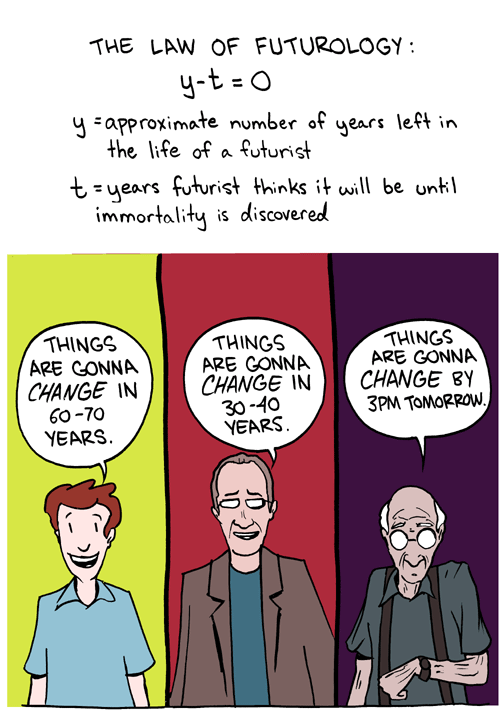
I'm convinced all of Kurzweil's predictions through the years can be simplified as (and originate from) "whatever least-implausible dream scenario allows a man of Ray Kurzweil's exact age and health to barely avoid the hitherto-universal icy grip of mortality."
Tangentially related in terms of "old stuff from other things I read", this 2006 critique [0] by Derek Lowe:
> Later in Kurzweil's article, he says:
> > "So what does the future hold? By 2019, we will largely overcome the major diseases that kill 95 percent of us in the developed world, and we will be dramatically slowing and reversing the dozen or so processes that underlie aging."
> [...] I really do expect to put cancer, heart disease, the major infections, and the degenerative disorders in their place. But do I expect to do it by 20-flipping-19?
It's hard to be optimistic when it's been those 13 years plus another 7 and somehow measles is back again, although I admit that's one isn't a pure technology-problem.
But that's kinda the point, there's no such thing as "a pure technology-problem". I think that's the fundamental - and obvious - thing that these folks seem to constantly miss.
Reading through them, Luu's grades seem fair and accurate to me. Best defense of Kurzweil I can give is that if you give a grace period of a decade and scope them down substantially (to maybe a subset of well-off Americans in coastal cities), he looks much better, though still under 50%.
One of Kurzweil's close-but-no-cigar failed predictions was "neural nets and genetic algorithms," killed off by the conjunction and being a couple years too early (2009 for increasing interest, and 2019 for wide use).
Fair, sure. But it seems to be underselling how reasonable Kurzweil is.
We've got things like 2009 - "Computers can recognize their owner's face from a picture or video. No." And ok, sure, but that has happened by 2026 and we have more than 2000 years of recorded history of people making predictions.
I don't think that situation reflects at all badly on Kurzweil except that he doesn't explicitly say he has a 15 year error bar. Which, yes, technically inaccurate, but it seems quite likely nobody would be talking about him if he spent that much time exploring the minor caveats.
And hitting him for the "and genetic algorithms" is verging on pedantry. Ok so genetic algorithms aren't a civilisation-level success that appears to be reshaping the fate of the species in the same way neural nets are. He was right that learning systems were going to be huge and he was off on a detail.
> We've got things like 2009 - "Computers can recognize their owner's face from a picture or video. No." And ok, sure, but that has happened by 2026 and we have more than 2000 years of recorded history of people making predictions.
If he was often right-but-early about things that weren't even in the hypothesis space for everyone else, that would be huge, even though his dated predictions would technically be wrong. But this example seems way less exciting. Facial recognition was not a new or impossible-seeming idea, so the remarkable thing about his prediction was the part where he said "by 2009". (And yeah, 15 years is a short time compared to 2000 years, but 'recorded history of people making predictions' is not really a serious reference class for his predictions. He's a guy in the computer age making predictions about what computers will do.)
The list in the appendix is pretty telling: Yes, the moments are off by a lot, but many of the predictions describe reality well.
I'd say that 7% accuracy is on the low side and 86% on the high side. Looking through the list I'd put it more at 50-60% personally. For me that still means that I'd much rather hear about what he has to say about the potential future than most other people.
If you grade what was linked by whether it is "approximately achievable today", and not some less interesting metric like being predicted for the correct year or if it was outcompeted by some other thing, he's closer to 70-90% depending on how close you're willing to grade.
It's very easy to say 'person X made a highly specific testable prediction, while respectable people said nothing like it would ever happen, and it only 90% happened, so person X was a fool unlike all the respectable people', but it's a trap. In reality Kurzweil was directionally correct about most things, overspecified the details, and had optimistic timelines in the way that everyone has optimistic timelines about everything.
> while respectable people said nothing like it would ever happen
Can you give some examples of predictions he got roughly right where this applies?
(Not a gotcha, I'm genuinely interested, because this is the key for me when thinking about whether to give credit for 'close' or 'right but early' predictions. If you're predicting things that most others have dismissed as impossible, or nobody has even thought of, then it's pretty impressive and interesting when you turn out be even roughly correct. (I'll still ding your credibility if you are overconfident about dates and details, but I'll do that while paying plenty of attention to what you say next.) If you're predicting things that are already suspected to be possible, though, and what makes you stand out is your confidence and your timelines, then I'm not going to be very interested when some of your predictions turn out to be fairly close to the truth.)
Altman and Zitron are like pro wrestlers. Their speech acts aren't for truth, they're for some spectacular effect on your feelings and your imagination that keeps you coming back for more.
I encourage anyone interested in this to read On Bullshit by Harry Frankfurt, the best popular philosophy work in a long time.
Ed Zitrons wild claims might be for entertainment value, but Altman’s are for his own valuation. He’s bringing in hundreds of billions of dollars off those claims.
Without reference to either person, I think this is essentially a misunderstanding of Frankfurt’s analysis: On Bullshit is about expressing sentiments without caring about their truth value, i.e. the concept of a “bull session.”
Both Altman and Zitron are the opposite of Frankfurt’s bullshitter, because they both appear to evince genuine care for the truth value of their position.
(Frankfurt is very subtle about this, in that he distinguishes the kind of performative lying you’re suggesting as distinct in moral and rhetorical content from bullshitting. The liar wants you to believe a specific thing; the bullshitter wants to regale you.)
Bullshitting is where you don't care about whether what you say is true. Your goal is to influence a certain way of thinking or feeling, and you just say stuff that you think will cause that in other people. Appearing to care about truth is not opposed to that, it's part of it.
I don’t think these mental states are in evidence for either of them. I think they’re both credibly earnest in their views.
(Frankfurt’s characterization of the bullshitter rests on not just the truth value being absent, but also on the bullshitter’s misrepresentation of what he’s “up to.” I don’t feel that either Zitron or Altman is misrepresenting what they’re getting up to.)
I mean, the point of Frankfurt’s bullshitter is that we know they’re bullshitting (or more expansively, Frankfurt gives us a set of criteria to test them against). We know they don’t care about the truth value of their statement, only that they are misrepresenting themselves because of a hidden “enterprise.” But there’s no such unknown enterprise in either’s case, and neither appears to be misrepresenting themselves (to my point about appearing earnest). Maybe that latter part is itself deception, but without the former they would fall into Frankfurt’s classification of a “liar” instead.
(I have to admit a bias when it comes to Frankfurt: I don’t think On Bullshit is that convincing. In particular, I think Frankfurt doesn’t do a good job of motivating the connection between bull sessions and bullshit in his strong sense, and many of his examples - like the Pascal/Wittgenstein one - don’t demonstrate misrepresentation either.)
> Both Altman and Zitron are the opposite of Frankfurt’s bullshitter, because they both appear to evince genuine care for the truth value of their position.
I can't really judge Zitron, but when it comes to Altman, I have absolutely no idea how you arrived at that assessment. In my view, he's clearly dishonest. I’ll remind you of his attempt to use government intervention to erect barriers to market entry for his competitors. Or his claims about AGI being just around the corner—claims that haven’t come true so far and were clearly aimed at investors. I’ve never heard a single statement from this man that struck me as honest.
I think it’s appropriate in this day that people have to really shout and lament on and on about their thing just to get a few people to listen and/or consider parts of their argument. Nobody listens if you’re just casually proselytizing your grift.
Kurzweil made one big claim — Singularity around 2045. Everyone at the time thought it was a total joke and hundreds of years off, if even possible. Now, that is seen as a laughably long timeline.
The rest is noise, I don't care what minor predictions he was wrong about, he called the big trend back when nobody else could make a trendline.
The fact that you know Ed Zitron's name means that, regardless of his predictions being consistently wrong (which they are), his strategy for manipulating human attention has been correct.
The question is whether he sincerely believes his own predictions or if he cynically is aware that you can create a career for yourself being a guy who says bombastic clickbait-worthy things people emotionally want to be true, instead of measured assessments of reality.
Problem is, you wouldn't know Ed Zitron's name if every piece he wrote basically said "AI might be a bit overhyped short term but will have lasting economic impacts." Booooorrrring.
The reverse is also true. OpenAI and Anthropic aren't going to get much media attention if they don't make silly claims like "all white collar jobs gone in 2 years."
And no, this isn't a new problem due to "the algorithm." Media has always been like this. Zitron is just another Peter Schiff with younger skin. The problem is human nature in general.
Hence why AI isn't going to kill media. We don't actually want sober, rational assessments of all available information from hyper-intelligent LLMs. This is unsatisfying. We want emotional validation, drama, adversarial identity and spectacle. Truth is rarely what we are seeking.
> his strategy for manipulating human attention has been correct.
"Correct" is not the word you're looking for here. More like "very effective". His strategy for manipulating human attention is very effective, but the correctness of his strategy isn't relevant here, so I'm not sure why you're bringing that up.
Luu is pretty specific about the predictions Zitron is making, has taken the time to pull them out and date them, and they're both risible and not rescuable with vibes.
His point isn't that Google or Meta are doing well or have bright futures. Luu is generally critical of tech giant engineering and product culture. He's critical of Google in particular in this very article.
But the point of the article is that it's not enough to have directionally satisfying vibes. If you made concrete forward-looking predictions and they're catastrophically wrong, that matters. If you make backwards-looking predictions that were literally wrong the moment you published them, that matters even more.
"Did you read the article" is a frowned-upon response on HN. The better way to write that kind of response, per the guidelines, is "the article mentions that". So: the article mentions that.
I don't know if directed at me because I didn't ask if one read article.
> it's not enough
It's enough for some of us, like his broad predictions that work on timescale of business cycles seem directionally correct. Even considering we're dealing with fast hardware deprecation cycles it will take years to play out especially with investors and incumbents burning through accumulated war chest. Luu seem oblivious to notion that companies with trillions in market cap can certainly out manipulate fundamental short / medium term market sanity. Part of Zitron's rant I find similarly compelling is the danger of dismissing directionally "satisfying" vibes because $$$ can capture reporting distort reality, which is only going to lead to bigger/more painful correction because directionally "correct" was dismissed as merely directionally "satisfying."
Let’s say it’s fine to give emotionally based arguments the same credence as rational arguments. That’s a huge cede, and yet, it doesn’t change anything, let’s see here:
If my cousin kept ranting about my other cousin was going to go bankrupt and fail and it was 3 years later and their income was up 2x I think I’d stop listening.
I worked at Google from 2016 to 2022 and agree with everything he says and you say, modulo the companies who are 2-3x on revenue and profits are going to 0. I worry that both of you have found a real problem but misattributed it, and insisting emotional arguments are the same as rational prevents you from participating in real fixes (ex. metas problem isn’t AI, it’s that they have a god-king CEO who cannot be deposed and monopoly profits. Imagine a twin of you and Zitron but instead of AI it’s 2020-era VR. If they weren’t focused on how their emotional argument was fine, they’d be your compatriots in noticing something’s off in Big Tech. Instead, we don’t hear about them because that battle was fought and lost years ago, and they lost credibility due to imagining Meta was going to 0)
Zitron gives timelines, and they don't come true --- in fact, the opposite thing happens. You can't come back to that with "well, it hasn't happened yet". By that logic, no prediction is ever wrong; wait long enough and maybe it'll come true. That can't possibly be the logic you'd hang your hat on here.
> Luu is pretty specific about the predictions Zitron is making
He is not, though. He precisely points to imprecise predictions, decontextualize them so he misses the point of the ones this thread is focused on, analyzes them with even less precise rationales that don't really rebut the prediction, and points suggestively (enough that you seem to have got that suggestion) that this rebuttal destroys the main prediction of every Zitron piece, while saying otherwise several times at the end of the rationale.
Zitron's predictions aren't all very good, but this article isn't either.
I say this with all possible respect, reverence even, for what Tarn Adams has accomplished and what continues to work on, but there may be no worse messenger for the problem of disintermediating game designers and creators from actual code authorship than the author of Dwarf Fortress. It's an amazing game that succeeds in spite of and not because of its code. Had Adams been able to use Opus or Sol when he started with DF, that game would be a broad cultural milestone today, and not just a nerd affectation.
I don't think there's a way to really say a comment like this "with all possible respect" given the (albeit meager) content of the article.
Either way, I'd be much more willing to bet that if Toady had Opus/Sol/whatever we wouldn't have Dwarf Fortress, we'd just have Rimworld: perhaps a technically better game, but not !FUN! in the same way Dwarf Fortress is fun.
Why not? The code is famously convoluted and slow (see: dfhack). It's still an amazing accomplishment, but that doesn't make the code itself a challenge frontier models today aren't up to.
There is no universe in which Dwarf Fortress becomes a "cultural milestone." It's core concept and gameplay would never appeal to the mainstream.
The premise that the only thing holding it back is not using an AI seems far fetched. How much game code have you looked at? If it shipped, chances are it's a goddamn mess. People made memes about Undertale's thousand-line switch statement. But it isn't the code quality that makes a game (unless it breaks, if it works literally no one cares) but the design and intent behind it. Using an AI wouldn't result in anything as unique or as innovative as Dwarf Fortress. It would just get something forgettable and mediocre to market faster.
This seems to be miss the topic. Isn't the topic about AI and how damaging it can be? I am not sure why you want to discredit the messenger; the message appears to be correct. That should be a better focus.
> Had Adams been able to use Opus or Sol when he started with DF, that game would be a broad cultural milestone today, and not just a nerd affectation.
Well, that is an assumption. You have to demonstrate this claim. Right now I do not believe that claim.
So what we're saying here is that personal computers can run open weights models that can literally code earlier versions of Dwarf Fortress all by themselves, but handling lines of sight for a 101st dwarf in a mountain fortress remains past the frontier of computer science. I love this so much.
O(n²) scaling is brutal. If n=100, then that is 100×100=10,000 mood checks. When n=101, that grows to 101² = 10201. 102² is 10404. You see how fast it is growing¹? Every person you add causes far more mood checks than the last person you added. There is nothing that computer science can do to reduce this growth. The whole study of computer science is the study of the limits of computing, and these are the limits. No amount of brain sweat can reduce the the rate at which the problem scales.
Of course we could redefine the problem; make each mood check simpler, for example. We could simply leave some of the current factors out of the calculation, so that the calculations are cheaper to do. For example we could make the mood check ignore consanguinity. A dwarf’s reaction would depend only on whether they saw a friend or not, but not on whether they saw a cousin or a sister. That will allow us to scale to higher population counts, but we still face the fact that there will be _some_ population limit.
Or we could reduce n somehow. For example, we could arbitrarily decide that some of the population doesn’t participate in line of sight checks. Maybe livestock are never checked at all, so the 50 cats don’t make n bigger. But then your cats won’t run away from zombie invaders, because they don’t check line of sight to see what is around them. Is that acceptable? Maybe, maybe not. Maybe it’s disappointing to to the game designer but they go ahead with the change because the players will still have fun.
The third thing to do is to optimize the mood checks so that they use the processor more efficiently. This is hard but doable, and can be done without changing the problem. And in fact it has already been done, to one extent or another. But modern processors are actually pretty hard to optimize for, and all the low–hanging fruit has been picked. For example, I have a 16–core CPU, and until a few years ago the game could only use one of those cores to run the line of sight checks on. The other 15 would be idle. That obviously leaves a lot of performance on the table. Now that the game uses all 16 cores equally you’ll find that n has gone up quite a lot. But it didn’t go from 100 to 1600, it went from 100 to about 400. 100²=10,000 line of sight mood checks, and 400²=160,000 mood checks. But once spread over 16 cores that’s still 10,000 per core! So now it can do the line of sight mood checks for a population of 400 in the same time as it could do them for a population of 100, only a 4× improvement. And if your CPU only has 8 cores then the new limit for you is really a population of about 283, etc.
But there is still more processing power in our CPUs that is going untapped by DF, and language models are actually really good at making use of that power. A modern CPU can run SIMD, or Single Instruction Multiple Data, instructions that can operate on many values at once. It can multiply two numbers together, or it can multiply a vector of 4, 8, 16, or even 32 numbers together all at once. And multiplying the vectors takes the same amount of time as multiplying two ordinary numbers! All a language model is doing is repeated matrix multiplication, which boils down to multiplying lots of individual numbers together. An LLM is _only_ doing vector instructions on 32 half–width floats at a time, over and over again, but DF doesn’t have that luxury. Most of what DF does just cannot be done using vector math in any useful fashion. The graphics could be (sprite compositing), but DF sends all of the graphics over to the GPU instead. So LLMs are not an apples–to–apples comparison for Dwarf Fortress.
This is a fantastic comment that I don't deserve for making fun of the complexity of Dwarf Fortress in comparison to the space alien technology we're building elsewhere. I come from a place of love (and fear --- I refuse to install it again) with DF!
I think this is not really a good way to divide up the space. It's obviously true that there are non-NAT firewalls. But NAT was introduced as a firewalling technique. In the first decade of firewalls, there was a whole taxonomy of different kinds of firewalls: application layer gateways, packet filters, "stateful" packet filters, and, yes, NAT.
NAT wasn't so much normalized as a security feature as it was introduced as one. The flagship NAT product of the 1990s was the Cisco PIX, a firewall. It resulted from Cisco's acquisition of the company that originated NAT.
Yes, I remember the PIX! After my time at a few early ISPs, I briefly had a corporate networking job and a PIX was one of the first hardware firewalls I deployed.
She had very high levels of mercury in her blood, and all attempts at chelation therapy to remove it were ineffective. That’s surely because it had spread throughout her body by the time the problem was recognized, but frankly no one can be sure if there were any measures that could have been effective enough after the initial exposure.
Is this accurate? I read the original Wetterhahn report (it's the first search result on Google) and chelation did appear to reduce whole blood mercury, but didn't do anything for the CNS exposure.
That would be important because it suggests immediate Succimer treatment could avert fatal CNS exposure (it takes hours/days for the blood/brain transfer to occur, apparently).
There are also some studies suggesting that the amount of excess mercury in fish compared to selenium may be more relevant than the absolute mercury concentration in causing potential toxicity.


Luu's post includes a (long!) list of specific predictions that aren't "exacerbated"; they're simply wrong.
Luu's point isn't that AI is going to succeed or that the "AI bubble" will never pop. It's that these predictions are all wrong. If you agree "directionally" with Zitron, all that means is that you're skeptical of AI. That's a totally reasonable position to have, but it has nothing to do with whether Zitron's predictions are good or bad.
reply