Or we can just go to the demonstration that our flight instructor did in the first 5 minutes of our Aerodynamics 101 lectures.
Get a piece of A4 or Letter sized paper and try this experiment with it [0]. For best effect, hold both the edges closest to you in each hand and twist the front edge downwards to keep it straight and prevent the paper twisting which could inadvertently straighten it. (i.e. Not with one hand like he is doing in the video).
The Bernoulli principle with postulates the Venturi effect is about the only theory that can explain why the trailing edge of the paper moves UPWARDS when you blow across the top of the curved paper.
Sure but now try the same thing with a piece of metal.
No one questions whether the Bernoulli and Venturi effects actually exist. But airplanes are heavy and it's pretty obvious that the Bernoulli effect does not produce sufficient lift by itself.
As proof that most of the lift comes from deflecting air, I offer the fact that airplanes can fly upside down.
Haha this is a fantastic answer. Also, not most of the effect, all of the effect.
Do the same experiment with the paper, but rest the trailing edge on a table. The air can no longer be deflected downwards, so the paper will not rise.
Another one to think about, at the air metal boundary the air is stationary on both sides of the wing. So why is there a pressure difference? Bernoulli's law is valid only along flow lines and is a consequence pressure difference required to accelerate (or decelerate) a fluid. Since in the laminar situation flow does not occur from the top surface to the bottom (minus around the tips), direct application is nonsensical. If you integrated all flow lines from all surfaces however, you would get the correct answer.
Well, I just instantly disproved your hypothesis by holding a piece of paper against the front edge of my desk with it curving up and the trailing edge resting on the flat of the desk, then leant down and blew over the top of it... and the paper lifted at the back. QED.
Not sure why people are looking at the situation as ONE Venturi plane. What I am trying to explain is that there is effectively TWO - and expanding one over the top of the wing leading to a low pressure effect, and a constricting one below the wing leading to a high pressure situation. I wouldn't say that both provide equal amounts of lift, but the paper experiment, and the 747 in the boneyard proves it to a point.
Well, scale up the wind according to the weight of the metal (and the overall surface area of the metal) and it can happen, as evidenced by this 747 in a boneyard 'rotating' under heavy gusty winds [0] (taking into account the massive weight and CoG difference without the engines on).
Extend the flaps and slats on that aircraft and I am sure the effect will be all the more pronounced.
And yes I've flown aircraft inverted too - it take a tremendous amount of forward stick to try and maintain level flight in that config to counteract the wings natural tendency to move towards the top surface.
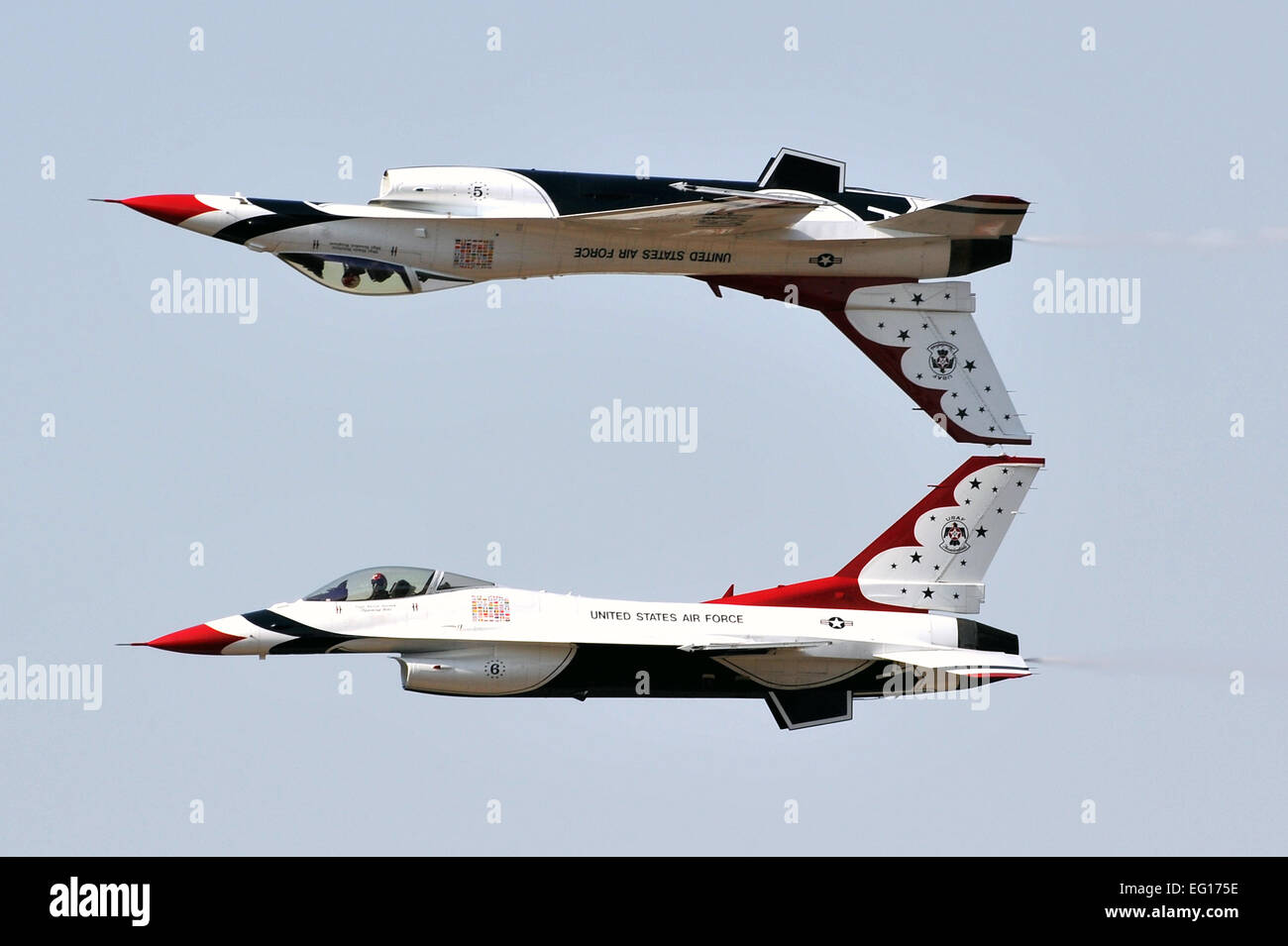
People have pointed out the "Thunderbirds" F-16s flying in the "mirror" formation [1] and not displaying much difference in AoA between the upright and inverted aircraft, but supersonic fighter usually have a straighter, almost trapezoidal shaped wing cross section rather than a curved 'fish' shape. I am willing to bet the inverted pilot has a fair bit of forward stick on though.


Get a piece of A4 or Letter sized paper and try this experiment with it [0]. For best effect, hold both the edges closest to you in each hand and twist the front edge downwards to keep it straight and prevent the paper twisting which could inadvertently straighten it. (i.e. Not with one hand like he is doing in the video).
The Bernoulli principle with postulates the Venturi effect is about the only theory that can explain why the trailing edge of the paper moves UPWARDS when you blow across the top of the curved paper.
[0] - https://www.youtube.com/watch?v=R3VVbajPqc0