Has the 8 second quarter mile been confirmed to be done in stock trim (i.e., no special tires or other modifications)?
The reason I ask is because that is EXTREMELY impressive. I tune EFI systems on race cars as a hobby, and any car in the 8 second range usually needs to run slicks or drag radials to have enough traction.
Even all wheel drive cars (GTRs, DSMs, EVOs, etc.) usually run 4 slicks once they get to that speed.
It seems very hard to make a pass like that on regular street tires, even with AWD.
EDIT: To add, I'm not knocking Tesla here, as there are very few cars that can actually run an 8 second pass off the showroom floor without any modifications at all. Even if they had to put slicks on the car to reach that time, that still puts it on par with 1000 HP dedicated drag cars.
Yes but in those cars traction control is usually off. In Tesla extremely precise traction control may work in your favour giving only as much power as tires can handle effectively allowing to near zero time loss on regaining tracktion. In quarter mile cars you don't have option, either tire will handle all that power or slip causing time loss.
Modern high-end aftermarket EFI systems (such as MoTeC) do have traction control, but it's not as effective as one would expect.
The main issue I found is that street tires often just don't have the traction required, even under ideal conditions. The result is that traction control has to cut power so much that it ends up hurting the quarter mile times.
It does help tremendously on consistency and safety though. Things start to pucker when all four wheels start hazing in a 1000 HP AWD car.
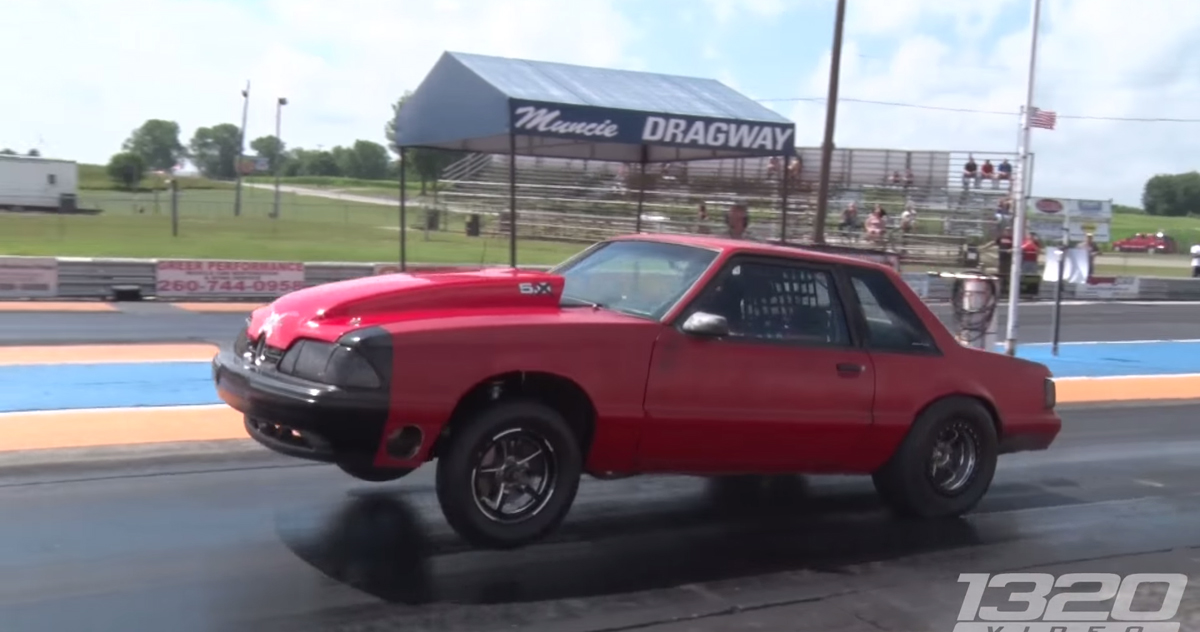
You seem familiar, but for others, here's what a typical 8 second car looks like leaving the line:
EDIT: Added picture of an 8 second all wheel drive car (GTR). The interesting thing here is the clear bias of traction towards the rear. When launching a car with that much power, the weight shifts towards the rear enough to render the front wheels almost useless (unless the suspension is extremely stiff).
I suspect Tesla's advantage is in linear acceleration. Those internal combustion cars need a gearbox so the initial acceleration is very high in that first gear. This the same reason the Navy wants to go from steam to electric catapults: you get the plane to the same speed off the cat, but the acceleration curve is straight, so there's lower peak load on the airframe, so your planes last longer. Similarly, the Tesla can keep linear acceleration with gear shifts.
Right but to hit an 8 second 1/4 you're trap speed is 170-190 depending on how fast your 1/8 mile was. There simply isn't even distance to accelerate linearly in 1/4 to hit 8 seconds without leaving the line like a bat out hell.
The suspension on most of these cars is also far from normal. There's very few cars in the world which make an8 second pass on independent rear suspension. Most of these cars have straight axles and 4 link suspension.
I really want to see a Tesla Roadster make an 8 second pass with whatever tires it needs because tires alone won't get you there. They got some serious engineering in that thing to make it hit 8 seconds with a suspension that doesn't make you hate life.
Accelerating at > 1g off the line has its own set of issues - without extra downforce from somewhere you have traction problems regardless of tires, street tires just make it worse.
This is why you see so many approx 2.9s 0-60 times in higher end sports cars, it's hard for aerodynamics to affect it much over the first couple of seconds.
Correct me if I'm wrong, but isn't downforce an aerodynamic issue? There are no aerodynamics at 0 mph. You do have a torque problem, but the Tesla is actually a fairly heavy car, is it not? Also, isn't Tesla's center of mass pretty near the same height as the axles? So it's not like the rear end is going to get under the front end.
Sorry, i just worded it badly. The point is that without downforce, you can't overcome the traction issue. To a first approximation at 1g accel from a standing start, your resulting force vector is at 45 degrees (mass at 1g down, accel at 1g forward). Accelerating harder just makes the problem worse. At speed, the answer to this is downforce (e.g. how F1 cars can corner as fast as they can).
But for the first couple of seconds, you can't generate much downforce from aerodynamics because you aren't going fast enough. And there are limits to what a spoiler, etc. can generate. For a lot of street legal sports cars, this all evens out about the same way, and they end up with very similar 0-60 times.
If you try and systematically knock down all of these problems, you'll end up with a top fuel car. In that case you may get ~1000lb of downforce from exhaust alone, which gets you past the first bit while you are going too slow for the big wing to be really effective.
There are some IRS cars capable of going 8's. The ones I've seen the most are GTRs, Supras, and the occasional 2JZ/LSx swapped 240sx (I think they swap a Nissan/Infiniti Q45 rear into it or something).
Now that the 2015+ Mustang has IRS, I expect to see more of them as well. I think there's already one in the 8's.
But yeah, IRS is a major pain at that power level. Most (all?) of the performance cars today have IRS, so I expect improvements to come.
Wow, the buckling of the tire wall in the last two pictures is crazy. I guess that happens because there is enough friction to stop the wheel moving, and the axle is trying to turn it faster, causing a shear force. With normal tires, I assume they would just slip at that point and spin because they don't have enough friction in the contact patch touching the road.
Yep! The tires are actually designed to do that. It really helps to prevent things from snapping by absorbing some of the shock when the cars drop the clutch or let go of the trans brake.
Thanks, that's really interesting - there's some amazing technology going into what I had previously assumed was a fairly boring static (modulo the rotation, of course) component of these vehicles.
I'll be amazed, amazzzzed, if that car, stock, can create enough down force to keep itself on the road with stock tires, I don't care how good your TC is. Look at the size of the wing on the new Zr1 https://youtu.be/O_adY_b-aLQ?t=3m14s
Downforce is more than the wing. You see those giant diffusers in the back? Those work as venturi tunnels, creating a sucking force, sticking the car down.
As a matter of fact, F1 cars in the 70s-80s were using venturi tunnels that extended the entire length of the vehicle. This is impractical in a modern gasoline-powered car.
Theu were even getting so good with their aerodynamics that they were rumoured to be generating more downforce with ground effects than from wings.
In an electric car, you could do what they were doing back then.
I guess I'll be eating my hat then. I'm pretty amazed that you'll be able to keep it planted that fast around corners, but if you can, this will be an incredibly fun (or maybe very boring!) car to drive.
Just pretend, the same way they do with the claims about the GTR's ~0-degree wing, and most all aero claims on street-legal cars.
Aero at street legal speeds is basically worthless and range-destroying. Many supercars don't have more aero than the Roadster, just go look at them, they usually either have no wing, like the Lambo Huracan, or a wing with virtually no angle of attack.
Wing shouldn't matter all that much in this case. Grip is most important in the initial moments of acceleration on the drag strip where having a wing isn't quite as important. This car[1] runs in the 7s without a wing at all.
Oh absolutely. That car is almost certainly a tube frame with a fiberglass shell.....was what I was going to say but then I looked into it and actually it's still sheet metal and weighs 3800 pounds. It has run a 6.987, and probably has north of 2,000 horsepower. Oh and it is street legal.
I'm confused. :( You think the hotrod will weigh the same as or more or less than the new roadster? I looked around and I couldn't find the roadster weight anywhere.
> Even if they had to put slicks on the car to reach that time, that still puts it on par with 1000 HP dedicated drag cars.
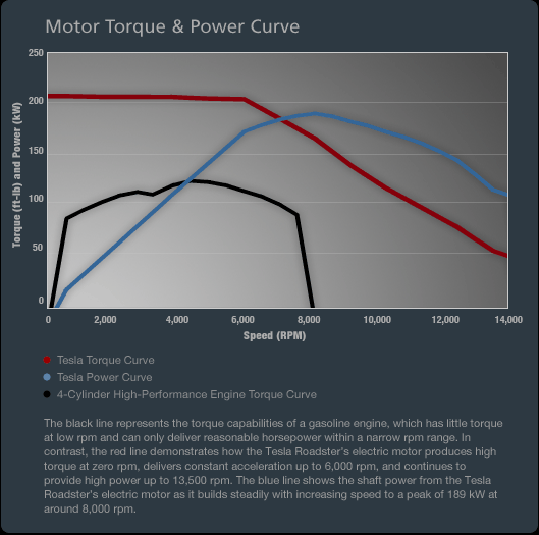
Horsepower is a misleading figure, because 1000 HP means a maximum of 1000 HP at some engine RPM. So, in other words, if a gasoline car delivers 100 HP @ 0-2000 RPM, and only delivers 1000 HP between 5500-6000 RPM, we call it 1000 HP.
The Tesla delivers its power constantly, from 0 RPM and — more importantly — its torque is also constant and available from 0 RPM. Add to this the fact that an electronic drive train can adjust the power independently for each wheel 100 times per second, which is simply impossible for a combustion engine (mechanical parts transferring that much power can’t switch that fast).
> — its torque is also constant and available from 0 RPM
I don't think torque is constant. The power is constant, and torque gradually decays as RPM increases as per the following equation:
HP = Torque x RPM ÷ 5252
Most 1000 HP drag cars are in their power band from the time the driver lets go of the trans brake until the race is over (unless it's a stick shift, but most drag cars are automatic).
Like any other conventional automatic, there is a torque converter between the engine and the transmission which allows the engine to spin faster than the transmission input shaft.
At the starting line, the driver engages the transmission brake, which locks the transmission and allows him to floor the engine, which brings it up to the optimal RPM (and spools the turbos if so equipped). It's almost the same as if you were to hold the brake and floor the accelerator at a red light. The only difference is that the brakes on a drag car wouldn't be able to hold it back, so they use the transmission instead.
Then, when it's time to start, he lets go of the trans brake and the power is instantly delivered to the wheels.
There usually isn't an issue with not having enough power at the starting line. It's actually the opposite. High power cars usually have to limit their starting RPM to avoid doing a wheelie or losing traction.
Interesting. Do they do that on purpose or is it due to how the motor works? It's so flat that It seems like they limit the torque on purpose, perhaps to prevent breaking things.
The almost perfect linear decline after the constant part is what I would have expected for an electric motor running with a constant power.
They almost certainly are limiting the torque. Zero rpm torque on these electric motors goes asymptotic since torque is power per change of angle and the angle isn't changing.
Also he specified max torque was 10k newton meters which is absolutely enough to pull a steel driveshaft like taffy. That's triple the torque a semi produces.
I would say with 99% certainty it wasn't stock tires.
Tesla specs special tires because one of their selling points is "look how quiet EVs are and how little maintenance they need". Said special tires have increased mass over normal tires. Tesla also needs to spec something that delivers a reasonable service life under a big heavy Tesla. You can't just hand wave and say "it's a 700hp rocket, of course it eats tires" because that doesn't fit their brand image. Then there's rolling resistance. They can't spec something that has a ton of rolling resistance because it would tank range.
All of those design criteria require trade-offs from traction and each other.
Well, most of my friends happen to be "in to" cars, so I've spent a lot of time being around and talking about cars.
Since I'm "good with computers", I would always help them with their electrical issues, which eventually evolved into me tuning their cars and dealing with any other EFI related issues. Most tuners charge around $500, but I do it all for free, so that helps.
If you really want to get involved, seek out some car clubs in your area and check out some of the open source ECU projects (such as Speeduino). Usually, car hobbyist can be identified by a group of people standing in a parking lot staring at their cars. Most of them love to brag about their setup, so they're pretty receptive to people asking questions.
The OP is right that 8 sec 1/4 is extremely impressive, but he is wrong that there are few production cars that can run 8s. No production car runs anything close.
The fastest 1/4 mile production cars are supercars such as the Veyron and 918, which are at or just under a 10seconds.
Remember, an increase from 20->18 seconds is roughly a 10% increase in acceleration; 10->8 is roughly 20% increase over an already ludicrously fast million-dollar supercar.
The 9.65 time is impressive, and the engineering team design as well. However, the claim is arguably disingenuous. Consider one needs a long time to go through a list of impractical things to prep the car to actually achieve that time, such as laying down what is literal tire glue to the road.
You're right - I can't find any other car that can run 8's without modifications. There are some that can achieve those numbers with under $10,000 worth of modifications, but that's kind of irrelevant since we're talking about stock cars.
That's also why I am skeptical of this Tesla running an 8 second pass in stock trim. Is there a video of the pass?
Most of the 8 second cars I've seen are running slicks or drag radials, and usually weigh a lot less.
I'd be curious to see how Tesla managed to make a car that probably weighs over 4000 pounds have enough traction for those numbers using regular tires. Even with all wheel drive, 8 second Nissan GTRs usually have to resort to slicks.
If we're talking about anything, you can build a turbo Gen 4 LSx swapped Foxbody Mustang for very cheap (check out the sloppy mechanics group). The same goes for an automatic AWD DSM. Both of those have the potential to get into the 8's with little money, but it does take some fine tuning.
However, I'm assuming you are interested in brand new production cars. The cars I listed above are all old and do not compare to the Tesla in anything other than drag racing. If you're interested, let me know and I can go into a more detailed breakdown of the last car I tuned (LSx swapped Mustang).
As for new cars, it depends on how much work you're willing to do yourself vs paying a shop.
Here's a link to a newer 5.0 Mustang with a completely stock engine and a ~$8500 twin turbo kit. He does have other supporting mods (tires, suspension, torque converter) that likely put him over the $10k mark, but you can also save a few thousand on the turbo kit by piecing it together yourself.
"He estimates the car makes over 900 horsepower at the tire, but what really matters is the stock Coyote engine paired with an off-the-shelf Hellion turbo kit added up to an 8.6-second e.t. at over 150 mph."
True. GTRs are not the best for drag racing. I think the Alpha 12 (~1200 HP) GTRs are actually dipping into the 8's, but I was thinking more along the lines of a Mustang, which is one of the most common cars used for drag racing and is usually much lighter.
Many cars in the 1200 HP range are much faster, such as the "Red Demon" DSM which is somewhere in the 7 second range.
I was wondering that myself after seeing the 1.9s 0-60 time. My understanding was that anything under 2.5s was the domain of racing slicks and sticky compounds.
The car in the image has some monster tires on it. Doesn't give you the compression (or whatever you use to describe the give in the tire) friction you get with serious drag tires, but with a good four wheel drive system?
> I tune EFI systems on race cars as a hobby, and any car in the 8 second range usually needs to run slicks or drag radials to have enough traction.
Right, but you're comparing what is ultimately powered by the good old Karl Benz design from the 1880s, burning dinosaur juice, that has zero torque at zero RPM, needs to shift gears multiple times, and is about as responsive to control inputs as a cow munching on marijuana leaves - with a very different thing powered by something that has maximum torque at any RPM, has no gears, and responds to control inputs extremely quickly and with immense precision.
1. A drag car does not start at zero RPM. The engine is probably over 4000 RPM and under load before the race even begins. In fact, many cars have to dial their launch RPM down because it ends up making enough power to lose traction from a dead stop. Look up "trans brake launch" to see what I'm talking about.
2. Your comment actually further confirms my skepticism of the Tesla not being able to maintain traction. If an unresponsive internal combustion engine powered car has trouble, imagine a car capable of shocking the tires even harder.
I own a modern sportbike and I've done enough of quarter mile attempts to understand how the process works in general, even though it's not a 4-wheel vehicle.
The main point here is that the internal combustion engine has a primitive torque profile. You have to keep it in the sweet spot if you want maximum performance. Hence all the stupid tricks you need to play with gear shifts and the clutch and all that junk.
This whole coordinated ballet is unnecessary with electric motors, that's the point that you've missed. At any RPM, including zero, the electric motor is near peak torque. A whole range of complex issues that would otherwise need to be mitigated simply vanish, so you can focus on defeating other obstacles. Understand the difference now?
> If an unresponsive internal combustion engine powered car has trouble, imagine a car capable of shocking the tires even harder.
You're missing the point again. A much more responsive engine such as the electric power plant allows traction control to work much, much more precisely and respond much faster. No inertia from crankshaft assembly and transmission. No clutch. Torque goes from any value to any other value in a small fraction of a second. The feedback loop can operate that much faster, and with greater precision. Internal combustion engines are not even in the same ballpark.
Like I've said, I do own a racing vehicle powered by internal combustion. I am quite fond and proud of it, which is something I believe you understand. But it's game over for this technology. Electric engines are winning by all metrics and in all applications, either sports, or utility, or whatever. It's the end of an era.
Yeah. Nobody claimed that magic was at work here. Current tire technology has certain limits imposed by physics. But I suspect electric cars can get quite a bit closer to those limits, with a much faster traction control loop.




The reason I ask is because that is EXTREMELY impressive. I tune EFI systems on race cars as a hobby, and any car in the 8 second range usually needs to run slicks or drag radials to have enough traction.
Even all wheel drive cars (GTRs, DSMs, EVOs, etc.) usually run 4 slicks once they get to that speed.
It seems very hard to make a pass like that on regular street tires, even with AWD.
EDIT: To add, I'm not knocking Tesla here, as there are very few cars that can actually run an 8 second pass off the showroom floor without any modifications at all. Even if they had to put slicks on the car to reach that time, that still puts it on par with 1000 HP dedicated drag cars.