That was the most annoying part of bicycling Americas 50 years ago. Those slices dried up too easily or turned into mush. In Boulangeries of France they had bread-slicing machines, but you often managed to stop the operation beforehand.
For a decent bread, get a Bread Maker and do it yourself. They are ridiculously easy to use, they do most of the work themselves, you just need ingredients.
Once you figured out that you need to be almost "scientifically" exact with the measurements. The first few tries we just managed to create bricks you could kill a man with (by way of usage as a blunt force instrument, I'm sure if you tried to eat would break every tooth in your mouth and likely cause damage to digestive tract).
Same in the UK. "bread" is the spongy toast bread that somehow stays soft for 7 days+. I find even actual bakeries that make "artisinal" bread(and of course it has to be "artisinal", no one can just make a normal loaf of bread anymore without treating it like it's some special thing) must have only seen pictures of good sourdough, because it's almost never properly risen, it's about half height of what a good sourdough should be. And it doesn't even taste like a real thing.
Same with rolls(buns?) - you get these really awful "baps" everywhere, which are again this soft dough without any crust to them.
I've lived here for 12 years now and I yearn for some good bread. I know of one Polish bakery that does the real stuff, but it's 20 miles away so it's a very rare treat whenever I happen to head that way.
Blame Chorleywood; sounds like the setting for a children's TV programme, actually the name of the process whereby we get a bread-adjacent product that's suitable for mass production.
Chorleywood has its place - "floppy white bread" as we call it. It's improved over the years, too. Chorleywood brown bread
is no longer the grey loft insulation of my childhood.
Nowadays, there's a much broader range of breads available. I have 2 excellent bakeries within walking distance and can get good quality sourdough from several supermarkets, including from Poilane in Paris to my door via Ocado.
Ahh, one thing that people love about Latvia is the vast choice between different type of breads. You can get some very tasty, high quality stuff here. Sorry I don't know the proper names of different types of breads (rye, sweet/sour) and then for white bread, different tastes. Rye bread with garlic or fruits, with carrots. White bread based on kefir (if that is a word in English). Bread with different seeds. OR just plain tasty bread.
I wonder why rye bread and the sweet/sour one is nonexistent, for example, in Germany. But when someone comes here, he takes that bread with him :)
It's what we call grey bread here. Yes, I know, it kind of looks like that, but the taste is a far cry... Anyway, taste is the most subjective stuff and everyone has their own. But interesting that folks like our bread.
I don't know if it is because someone lived here and migrated and remembers the bread. I have only 1 datapoint that is not the case - native foreigner that loves our bread too.
TLDR: If you ever come hear, try different kinds of our bread and see if you find something that you really like :)
You can make bread that stays soft for 7days+ at your own house. You just need to add less water and more fat and sugar (in my case, I use butter and whole milk). I store it in a plate covered by a bowl, and lasts at least a week. Afterwards it starts to get moldy, but it doesn't harden.
I disagree, I have even seen Walmarts with bakery-made bread that's flour, water, yeast, salt, not too much sugar, and has a normal shelf life of 2-3 days. Most grocery stores have it. It certainly won't be the best you've ever had but it's real. Now if you said "there's no bread in the USA's bread aisle" I'd completely agree.
Of course there is. When I go visit family, I can still go to the supermarkets and find several types of freshly baked bread, not just mass produced white bread. Even among the mass produced stuff, there's plenty of decent options if you ignore the plain white bread.
Unpopular opinion: Bread in the US mostly is of low quality. Whole wheat or multi grain bread with a hard crust as it is common in Germany or Switzerland is superior in taste, texture and nutrition.
Why is that unpopular?
Generally speaking german bakeries are top notch, quite old fashioned, which is good. But the taste/style of german bread is debatable.
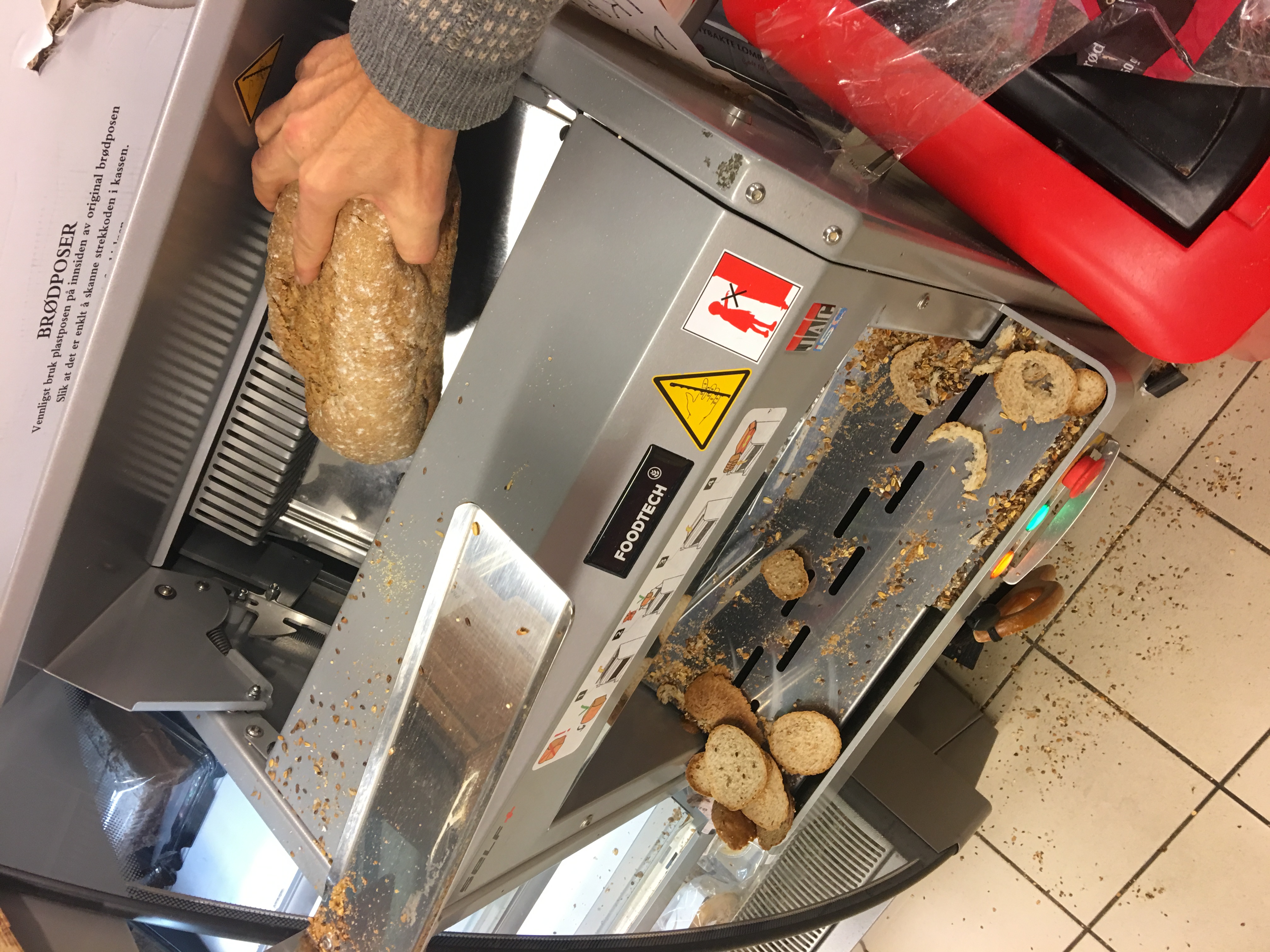
I remember when we had to cut own bread in a supermarket.
It was a machine with lots of sharp blades that you put a bread in and then pulled a lever and the bread w2as pushed through the cutting mechanism and it came out the other side.
How long do you save the bread? We eat it in at most three days and the it almost never goes bad within those days. Do keep it in a bag or storage container or it will dry out.
Sometimes we don't manage to eat a bigger loaf, at that point we usually dry it and grind it into breadcrumbs. It will dry quicker when not in a bag, but won't mould.
Bread that's too dry to eat but not yet stone-hard can also be fried or baked.
Is that sufficient for every family to make 22 slices of bread a day with no added waste, like the article says?
I vaguely remember slicing bread at home because my parents thought buying unsliced bread built character, and it mostly wasted it and covered everything in crumbs because they never sharpened our knives.
I know some chefs and they all say that once a bread knife in their restaurant is done they recycle it and buy a new one - sharpening just doesn't work that well on serrated knives unless you send them to be professionally sharpened in an industrial machine, but then it's literally easier to buy a new knife.
There's woodworkers who buy unsharpenable saws and throw them away when they're not sharp anymore. There's also those that buy sharpenable and sharpen them themselves or send them to be professionally sharpened. Do what you like.
I do it with my family of 3, and see no reason why it wouldnt work with a bigger family. Its up to you if you rather spend money and time on the store bought bread shaped sponges, or on slowly fermented & risen bread.
Tip: forget the bread knife. Just get a normal straight-edged knife and keep it sharp. Once it's through the crust it will cut as well as a bread knife (actually better, because it's easy to keep a straight edge sharpened which you can't say about a serrated edge unless you have a special sharpener) and you won't get a spray of breadcrumbs. Does need to be reasonably sharp, but I'm not talking razor-like. Try it.
I did to that before i bought my current serrated knife. But as others mention my non serrated would not get through the crust of sourdoughs. And the you end up crushing the bread and getting uneven slices. It was indeed cleaner than the crumbs i get now.
I keep a reasonably sharp straight edge knife (not razor-sharp), but find getting through the crust a chore with it (crust != crust, to be fair), and thus prefer serrated. Breadcrumbs all over are annoying though. Maybe keep a razor-sharp straight edge just for bread?
I usually have success puncturing the crust first and then "levering" the knife to create a wide cut that's easy to finish afterwards. Some bread just falls apart on its own, though, this works best on more firm bread.
at that point, you have a bread knife again, except it's isn't serrated. to my view, bread crumbs are unavoidable every time you cut bread crust, no matter how
In some places here in Sweden and in Israel shops sell good bread and have a slicing machine [1] available free of charge, of course the bread will dry out faster sliced but if you consume it the same day it's is not a bad compromise
I agree its hard to get used to the price of good bread, but the question is if its really expensive.
Here, in Amsterdam, a good sourdough is around 2-3 times more expensive than store bought bread.
But for me store bought bread has zero substance, i feel like i eat air, without taste, which is also costly.
So in my opinion, the value/price is much better with a good bread.
Id rather spend money on something with value.
Sure. But you have to have enough money to choose that. But I've been in the position where spending 2-3 times more on bread meant that later on, I'd go hungry. Buying two loaves is generally better than one if you are doing poorly. At the time, I was handwashing clothes in the sink using water heated in a boiler, since I couldn't afford the gas to heat air or water.
Two things about that: that is a wild generalisation, and so what?
Wild generalisation: sure there are equipment which shapes the dough automatically at that scale. Not every bakery has the volume to justify investing in it. So depending on where you buy your bread it might have been formed by such a machine, or by a dude in the back.
And even where the bread is made at massive scale: so what? The only question which should be asked: does it taste good? If they gave the dough the proper time to rest and rise then it will taste good. The fingerprints of the person forming the dough is not the important ingredient there.