    400,000,000 active users [0]
    16,000,000,000 USD
    ----
    $40 per user
That's an incredible cost. We can assume Facebook is paying for the userbase, the app itself and it's infrastructure would basically run itself. It's less appealing when you realise that there's probably a miniscule fraction of WhatsApp users that don't have a Facebook account.
> WhatsApp will remain autonomous and operate independently. You can continue to enjoy the service for a nominal fee
Pretty amazing that this is precisely what Microsoft paid for Hotmail in 1998 : $400 million for 10 million users = $40 / User. [1]
The parallels are striking : Whatsapp is to messaging today what Hotmail was to messaging in the late '90s.
I'll admit to a distinct feeling, that I've started to lose touch with pop technology. I've never heard of WhatsApp. Though I had most definitely heard of Hotmail in 1998.
It's not really "pop" technology. Surprisingly, it's not used much in the United States, but in India it's basically a replacement for text messaging. Everyone from a 13 year old child to my grand mom uses it to keep in touch with friends and family members across the globe.
IMHO, they were able to get to such widespread everyday usage because they such awesome and reliable technology. Much better than what Google have been able to provide with their hangouts app, for instance. Messages are always delivered instantaneously if you are online. If you are offline it stores it locally, and delivers it the moment you are online without messing up the order.
Never had any issues with them. They are really awesome. Congrats to them - IMO it's a great acquisition by Facebook.
My mom thinks whatsapp is the internet. That's the only app she knows how to use. I have standing instructions to recharge(pay the monthly internet fee) the "whatsapp" every month.
In Romania many acquaintances used it, but most of them have switched to Facebook's messenger. As I was saying in another comment, if I open my WhatsApp right now, most of the people listed as being on WhatsApp have probably uninstalled it, so there's a very real possibility that messages won't ever reach their target, whereas the new Facebook Messenger for Android is catching on like fire.
In my opinion, this is probably the dumbest acquisition I've ever seen.
When they say "450 million monthly active users worldwide and over 320 million daily active users", it's probably safe to assume that they have discarded inactive users. That's also depending on what their definition of inactive means (e.g. have not used whatsapp in 3 months?)
I had to join WhatsApp because most of relatives on Facebook moved on to WhatsApp and there are atleast like 6-7 groups on my WhatsApp. Friends, Office colleagues, cousins and other people.
I'm rarely seeing FB updates from my friends these days. Most of it happens on WhatsApp channels.
So its not a surprise FB bought them. Because if they don't they risk losing all users to WhatsApp, at least that's how it is here in India.
I'm in Ecuador and most young people (which is a lot here, the average age is 26) use a combination of Whatsapp, FB and SMS. Ex-pats avoid SMS as they are usually on pay-as-you-go plans on $20 phones.
It can't be like this forever, as the network effect leans towards a single messaging solution, the carriers will lose their hold on SMS as a revenue stream. But this will depend heavily on universal Internet access.
As one of those expats (starting my 8th year in a little fishing village in pacific coastal ecuador), can I just say --
We're on pay-as-you-go plans, but usually on nice phones we brought unlocked from our home countries. I'm typing this on my trusty Air, which is tethered through an unlocked iPhone 4S.
I'm also listening to waves crash. We got our first swell in a month yesterday, and non-locals are showing up a day late ... 4 or 5 of them. A crowd. I was the only one out for the good stuff yesterday, and I sucked the marrow out of it, and am instead enjoying sitting on my balcony drinking coffee and vagando here on HN. Ahhh.
Where was I? Oh, yes.
I can confirm the crazy-fast penetration of both smartphones in general (probably way over 90% android), WhatsApp in particular, and the FB/WhatsApp/SMS mix.
So WhatsApp isn't the internet here yet. But it's definitely got brand parity with Facebook around here. Which is pretty amazing considering their relative valuations.
I live in Bangalore too! It's just that most of my friends are moving from WhatsApp to Viber and remaining will hopefully move now. I have around 10 groups running from school, boarding, college, jobs and some more.
Fb buying them is a deal breaker. None of my "well read" friends are going to trust WhatsApp with those nude photos, short pornos or very very personal information we share.
I don't know. Facebook just looks like a desperate chap.
The value in Skype, WhatsApp, etc. is the vast amount of work and codebase that goes into punching holes in routers/gateways/NATs to make the internet actually work like it was originally designed.
WhatsApp is not p2p, they maintain a constant server connection which is not a problem for routers/gateways/NATs because its initiated from the client side.
Spam prevention is not strictly a security problem, or if you choose to frame it that way it is entirely unlike most other system security challenges. Almost all spam prevention systems have some sort of secret sauce involved, otherwise spammers could train their own systems against it to discover what works. In other words, this is why most open-source security products are extremely competitive with (if not outright better than) their closed-source counterparts, but open-source spam prevention systems (with no disrespect to the people who work hard on them, because as I said, it's a hard problem) suck.
Security through obscurity is not an invalid strategy. If the capabilities of your adversary are low (e.g., bottomfeeding spammers) and the obscurity changes often (e.g., churn in API) it can work just fine.
Trillian! Seriously...ok, I get that these apps like WhatsApp, Viper got tons of users, but please don't give me no BS about them innovating. Trillian solved that problem a long long long long time ago.
I used to really like Trillian, iirc even payed for it once upon a time, but haven't used it in forever... most of my family and a lot of my friends are all on FB, so I check there once in a while.. anyone else will SMS/text me.
If anything, I think I've used google hangouts than most of the other IM platforms lately.
More importantly, XMPP has problems delivering the text-message-like experience. It's more of a live-chat protocol. If you want to receive messages when you're offline, things rapidly become a mess.
They shouldn't, though, because pretty much every XMPP server I've seen has user-offline message storage for later delivery eg [1], [2], and the "best practices" have been documented for years, e.g. [3].
Unless you actually mean "receive messages [to your device] when you're offline" and how the hell would that work?
fortunately there is improvement in sight: XEP-313 Message Archive Management [0] allows a client to fetch the backlog from its server, at the (privacy) cost of having all your messages stored on the server.
By the time smartphones were widely adopted in the US, SMS already had massive market penetration. Trying to adopt something else when your entire social network already uses SMS is a losing game.
This is why, IMO, Apple, Google and Facebook are the only companies really in a position to change the messaging game in the US. There is space for newcomers (see: Snapchat), but they're going to have to work hard to spread beyond their initial niche.
Apple is driving iMessage adoption via iOS, albeit mostly only for messaging between iOS devices. Facebook has a solid mobile install base already, but they can't seem to figure out how to convince users to use Facebook messaging. It actually works really well for me, but no one I know actually uses it.
Google seems to be in the process of merging Hangouts and SMS. They're already the same app on Android, but you get to pick the protocol. Their logical endgame is to move all messaging to the Hangouts protocol, and fall back to Google Voice to deliver messages to users who don't have a Hangouts client.
If Google can pull this off I think they're going to absolutely kill it, but they seem to be having a lot of execution problems.
I don't know, SMS was huge in Germany as well, there were unlimited plans etc., still, today everyone uses WhatsApp. Group messages, broadcasts, media, cross-platform, and it's of course easier to convince people to use WhatsApp than Facebook.
I lived in the US for a while, and I can't really come up with any reason why it should be different there. Only that way more people are on Facebook (and those are also way more active). Still, I can't really explain why texts stuck around even for smartphone users.
Hm, I could imagine that for those with smartphones unlimited SMS plans came maybe a bit later in Germany than in the US.
When I was shopping for a mobile phone plan for my sister four years ago unlimited SMS were hard to find. Sure, now you get them everywhere, but I don’t think standard smartphone contracts had them four years ago. You had to pay obscenely more (something like double the monthly cost) if you could get unlimited SMS at all. I remember that the high cost of SMS were a real sticking point for my sister.
In my experience smartphone contracts in Germany tended to be much cheaper than in the US but you would also get substantially less for your money. That’s still the case today with included unthrottled data volume.
So maybe that’s one reason why Whatsapp took off. Another one I can think of is that Germany is less of an iOS monoculture than the US. Android is more widespread, so iMessage frequently gets you no benefit at all.
SMS was (still is) huge in the UK too, but all of my friends started using WhatsApp because you could send pictures to each other on WhatsApp without having to use MMS which cost more, was always a hassle to set up and wasn't available on every phone back in the beginning.
I'm in the UK and I'd never heard of WhatsApp until now. I wonder if a lot of these people who say 'X app is big in my country' actually just mean 'X app is popular within my social circle'.
> I wonder if a lot of these people who say 'X app is big in my country' actually just mean 'X app is popular within my social circle'.
Yes, that is exactly what it means unless there's some research data provided. Obviously it is easier to scale our current surroundings to the whole country, than to really go around and see how things are outside our social circle. Then again, same applies to you too, just because you haven't heard of WhatsApp before doesn't mean it wouldnt be big in the UK. :)
In Spain, SMS was also the main way of communicating with mobile phones (pre- and post-smartphone). The benefit of WhatsApp was that you didn't have to move to a different "social network" with usernames and stuff, it just used your contact list, and that it didn't cost anything besides your internet connection. So if someone had WhatsApp, you used that, otherwise you texted them through SMS. You almost end up avoiding communicating with people that don't have WhatsApp because they cost you money...
Really? Telegram is a trend? In India I doubt many people even heard about it.
I think I will give it a serious thought if it open sources its code base or otherwise it's as good as Viber or Line as an alternative. Same goes with helm.is.
In Romania WhatsApp is fairly popular, but it's declining. About 60% of my phone's contacts have had it installed at some point, but I noticed that many of them have uninstalled it.
Its popularity has been declining due to Facebook and Android - Facebook on Android works really well lately, most of my acquaintances are on Facebook already and everybody with an Android (which is most of my acquaintances) has either Facebook or Facebook Messenger on it. This is happening because Facebook is the messenger that finally dethroned Yahoo Messenger in my country - really, I'm serious, Yahoo Messenger was still really popular until about 2 years ago. And Android penetration has been phenomenal, due to cheap models being advertised by mobile carriers and sold instead of feature phones.
> Their logical endgame is to move all messaging to the Hangouts protocol, and fall back to Google Voice to deliver messages to users who don't have a Hangouts client.
You're a US citizen and so you might have missed the part where Google Voice is not available outside the US - no alternative can win over SMS, unless it is international.
I actually hate them for trying to take over my SMS messaging and I'm glad that I still have the option of not allowing them to do it on my Android, even though I'm also a regular Hangouts user. What is it with these companies trying to be everything to everybody?
re: your last thought. Google isn't really taking over your SMS messaging in Hangouts as it stands with their current implementation. If you enable "Hangouts SMS" -- it's really just a client side merge of the SMS and Hangouts UI (i.e. SMS does not flow through Google's servers). It just makes it easier to manage SMS and Hangouts conversations side by side through the same app.
I saw that, but if you take a look at the wording they use for denial ("Maybe Later"), that's what they did every single time before shoving it down on all customers' throats. Plus, that question pops up every single time Hangouts gets updated and there's no way to make it stop, because surprise, you can't uninstall Hangouts. The message on the wall is very clear - in future versions of Android Hangouts will be the SMS app.
> It just makes it easier to manage SMS and Hangouts conversations side by side through the same app.
No it doesn't, it's actually quite confusing. At some point I sent a message to my wife, without paying attention if it's SMS or not and so I sent it by Hangouts because that's the default, but she's not using her Google account at all and never received the message. And you have to pay attention like every single time.
It's much, much easier to separate services, when they are in fact different. For SMS, I open the SMS app and I send and receive SMS messages. For Hangouts, I open the Hangouts app and I send and receive Hangouts messages. When I'm not sure what protocol to use for somebody, I go to that contact's details and check out the available options. If I have to read new messages, I click on the notification. If I want to reply to a new message, I'm already in the right app. What could be simpler than that?
Trying to combine Hangouts or any other SMS alternative with SMS in the same app is first of all a huge usability fail - unless that service would fallback to SMS in case delivery didn't happen, in which case there's always the question of unexpected billing, because your phone number is going to have to send that SMS and SMS can get quite expensive - so no, it's an epic failure.
The problem with what Google or Facebook do is that deep down I know it's going to be integrated into their main product, and I won't be able to use it without sharing my real name and friends and everything else tied to the account. Or it will make me create an account, pick yet another password, fill out a profile, yadda yadda. Just thinking about it makes me sleepy.
Why can't it just be simple? Get the app and pick a phone number to message. The SMS situation is so bad that it's got a giant flashing neon sign "Disrupt me please" all over it yet none of the big players are stepping up.
I thought it was the de facto messaging app across the world?
There is no such thing. IM is extremely fragmented into local markets, and you will find different solutions being the de-facto solutions at different locations.
For reference, I'm from Europe and outside the Netherlands I have never heard of anyone using Whatsapp. I tried it once, and it found 2 contacts among my 100s. It was instantly deleted as it was of no use to me.
I also remember it causing stability issues with my Android-phone, ensuring I will never ever install it on anything I own ever, for life, unless my primary intent is ruining that device.
What's "hot" here, or at least what I've heard of people using is MSN, Skype, FB Messenger, Hangouts, Twitter(!) and IRC.
I can only speak for myself, but in the US I have never seen any need for it. I text or iMessage with my friends, and while I have had WhatsApp installed for a long time, I've never found something it does better for me. If I needed to communicate with people I couldn't text with, or if I were paying per text, it would probably be more compelling.
Well, to give you an example, here in Argentina, almost everyone in my phone's contact list uses WhatsApp. Here, the fact that you pay per message is a big incentive. But there are other advantages, like instant delivery, being sure that the message was received (double-check), better feedback ('X is online' when using the app, 'Last seen at 09:22', X is writing...), media sharing, groups, etc. simple things that help a lot. Also, it works both on iPhone and Android...
In Brazil, sometimes a SMS message takes hours to arrive. My bank sometimes send a validation code by SMS, but I can't use it because it expires before arriving.
Still struggling to figure out why it's so popular. I read the other article[1] on the front page suggesting that the reason for the popularity is that the app works on low end handsets. But then so does SMS. Is the design of WhatsApp so much better than built in SMS, or is it just the fact that WhatsApp is free? [For me and most people I know SMS is virtually free, but I guess that's not the case around the world]
- It's not 10c/p per message which if you're talking a lot adds up.
- You can send photos and videos and they show up in the stream. MMS isn't actually configured for most people even if it didn't cost 50c a message.
- It does group messaging.
- Avatars, UI etc
The reason it's popular over apps I think is largely down to savvy use of network effects, particularly that your username is your phone number, so it can scan your phone book and instantly show you who you know that has it. Plus it's available on iPhone, Android, Blackberry and as that article at the top of the main page says, J2ME (news to me but I'm in Europe so not that many feature phones around these days).
I'm from the UK but live in Barcelona and it has 97% penetration here.
[For me and most people I know SMS is virtually free, but I guess that's not the case around the world]
Define virtually free? I pay like 10 bucks a month for unlimited SMS, that's hardly virtually free!!! If I didn't they cost like 10 cents a message. That's an insane price for sending or receiving a very very small message that costs the phone companies almost nothing to send. I see it working well for say prepaid plans or barebones plans.
I would pay maybe £0.09 per SMS if I wasn't on contract. As it is, I am, but I still have to pay to get a delivery notification - that's £0.01 per message or £0.02 depending on your contract. I send maybe 100 messages per day on Whatsapp and probably about 3 texts.
Also, where I live (UK) literally everyone I know who has a smartphone is on Whatsapp. It's completely ubiquitous.
WhatsApp has huge global growth. I heard that little chirp everywhere I went in India. friends in Africa use it all the time. in countries with SMS charges, whatsapp is a good deal.
The funny thing is that in places like USA, you pay exorbitant amounts (~20 USD per month) for text messaging (when the real cost should be almost 0), yet it's still not caught on here - which is kinda sad.
They used bait & switch in Europe (at least where I was) to entice SMS adoption. There was a multitude of free SMS services: online sites where you could send someone a message for free or SMS a service that would forward it without being charged. Then, in the span of a few weeks, the services disappeared.
I have a hard time believing that the density of WhatsApp-capable phones is higher across the developing world (where WhatsApp is popular) than in the US.
Probably not, but it's close to equally high, which is one of Whatsapp's strong points.
Additionally, it's not just popular in "the developing world" (whatever that means), but also in many European countries. I haven't seen a map, but I suspect that Whatsapp is very popular nearly everywhere outside the US and China.
It's just because it matters more that we have all of our contacts than save $20 a month. I think you'd need higher priced SMS or a very large WhatsApp userbase.
Agreed, pretty much anyone in the United States above the poverty level seems willing to spend $20 a month for unlimited texting.
I'm way above that, yet I opted for the pay per text plan and paid 20 cents per text. All my friends made fun of me, but I saved a few dollars since iMessage didn't count toward my costs. However, it effected how people without iPhones would naturally choose to interact with me.
Basically, everyone loves iMessage, but no one thinks twice about alternatives. The general assumption seems to be that it's a god given right that you can send a text to a phone number. iMessage did such wonders obscuring that, whereas having to actually download some other app unveils everything.
>> Agreed, pretty much anyone in the United States above the poverty level seems willing to spend $20 a month for unlimited texting.
Even if you are at poverty level and qualify for a free phone (through the Lifelink program, or 'Obamaphone') you still get something like 250 texts included with that
That is a very good point, even if you don't immediately realize the deeper implications. :)
In India, you generally pay per text message - so if you can convince even 3 of your close friends to start using Whatsapp, you save (say) 20% of your phone bill.
Here in US, if you are going to send more than a few texts a month, you are going to be paying 20 USD. So there is no real monetary incentive (initially) for you and two of your friends to switch to Whatsapp.
The number of WhatsApp users in India is still infinitely less than the plain vanilla SMS people. Specially the ones living in villages which is a huge majority with a huger margin.
We also have SMS packs like 100 SMS a month by paying Rs 40 or so. But a DoT rule (which was actually twisted and misinterpreted by telecos) make that plan ineffective on any festive day and on those days you pay for each SMS and the rate is almost double or x3 or sometime x4 of what you would have paid without the SMS pack :-)
Indian telecom sector is highly regulated by the Govt. And it is very competitive. So there's no way such an all-or-nothing deal can be introduced so late in the game.
Edit: Moreover, the telecoms do make money on the data plans don't they?
The best part is most womenfolk at home, can use unlimited messaging if all they is a wifi connection and absolutely no balance on their pre paid cards.
Essentially WhatsApp is free messaging as long as you have a internet connection. And that's pretty cheap these days.
Here in Germany, nearly everyone in my Contact list with a Smartphone got it. Even though there are relatively cheap plans for unlimited SMS available.
> people (especially preteens) with an iPod Touch or iPad Mini but not a smartphone/texting plan
If I recall correctly, iOS WhatsApp is iPhone only. It won't run on anything that doesn't have a phone number and can't receive SMS or phone calls (necessary for activating the application).
Perhaps it's country-specific? I just double-checked and the App Store won't list it in the search on my iPad under iPad-only or iPhone-only, nor in Purchased. I'm in the UK.
When I first bought WhatsApp, I bought it in iTunes on my Mac. I only had iPod touches and iPads at the time, and it wouldn't sync the application to any of them. I seem to recall that I tried to follow a direct link to the App Store entry from Mobile Safari, and it said that my devices were incompatible.
I actually got to know about the Acquisition on Whatsapp! My friend from NYC messaged me on it. Unlike SMS, what I really like about it, is the group chat feature. At any given day, I'm chatting on a group chat with friends from here in the US, Canada, India, Singapore and the UK. For that I pay $1/year.
It's probably paid for itself in just a few days of use.
I second the group chat feature. my family had a constant group chat going on it. It works very well. I see that, and the easy way of sharing of voice, photos and videos as a big advantage over SMS.
Back in the day, I remember using AIM for group chat with friends and instant messaging. Although I've never used Whatsapp, it seems like a mobile equivalent of AIM.
Absolutely the same as AIM messenger or Y! messenger back in the days.
There are some differences which is possibly because it's the mobile equivalent.
One is that you don't have to add any new contact. If anyone on your phone book has whatsapp, they instantly show up i.e your identity is your phone number.
Two when you join a group if there is a person already in the group whose you know in real life, but don't have the number of, it's easy to get their contact into your phone book.
I was able to reconnect with quite a few of my old high school friends using whatsapp. The interesting thing was that everyone spread around the world. Many are in the US, but several are in UK, some are in the middle east, many in India, a couple in Singapore and the group chat made it possible for everyone to instantly connect without having to "add a friend". Plus, no cost difference to send a message to someone in the UK or India.
Like you said, it's the mobile equivalent but the group chat feature is what makes it really useful esp. if you have friends in multiple countries.
Have you been a heavy user? I have a sneaky feeling that they will let light users have it free, but start charging heavy users. That makes sense, because if you are a light user, there is not a lot incentive to pay.
Due to network effects, it makes very much sense to let frequent users ride freely (perhaps not bandwidth hogs, but frequent communicators with multiple friends), as they'll bring in and keep many other users in the system.
I use it every day and I got my free account expiration date upgraded to "lifetime".
Admittedly, I'm a light user regarding bandwidth usage; I do share some pictures, but probably a lot less than the average user. I honestly don't think I know anyone who pays the annual fee.
I'm an extremely heavy user, hundreds to thousands of messages and images per day, and I've had the same messages so I think it's the heavy users that they're allowing for free.
That can't be right since the UK App Store supports payments and WhatsApp have never asked me for any money (but I was a light user before I ditched it for LINE.)
I wonder if this is significant in requiring that the person then has set up payments; that must lower the friction on getting those users then to buy other things or make further payments. The time and effort expended is probably for many worth more than the dollar spent?
I've had whatsapp since before it was available in the play store (they had a beta you would manually download back in like 2010 or 2009 or something) and I've never paid a cent... maybe because I signed up when it was still "beta"?
how on earth do they charge it if you don't have a credit card associated with your play account? Because I've used whatsapp for well over a year and can't figure out how they'd charge me.
True, the reasons are different. But the motivation is the same : to stay ahead of the competition. In my view, and based on my own experience, Whatsapp is being used as a light-weight social network built around messaging and optimized for mobile phones. In fact, I share a lot more stuff with friends and family on Whatsapp - including pictures/videos/messages - than I do on Facebook.
The more Whatsapp satisifies my sharing needs, the less I use Facebook. And that is a competitive threat to Facebook. Instagram was similar - a light-weight social network built around photo-sharing.
I think Zuckerberg is a deeply strategic thinker trying to avoid the pitfalls of the "Innovator's Dilemma". Both Instagram and Whatsapp are classic examples of what is described in Innovator's Dilemma - light-weight products that can slowly eat into the market share of the incumbent, and ultimately displace it.
But it in no way ensures they stay relevant. It is literally just blindly flailing around buying anything that gets a lot of users out of fear and having no idea how to maintain their position.
>It doesn't ensure they stay relevant but it's a better strategy than watching your target demographic leave your platform.
I don't see any evidence to support that claim. It is a different strategy, but I don't see any indication that it is better. Flushing a few billion dollars down the toilet is a different strategy too, but that doesn't make it better.
But they are trying only with tricks and short term solutions just to keep their stock prices high. Acquiring everything isn't a planned strategy for growth but rather a fear of the next facebook strategy, which obviously is not and couldn't be WhatsApp. Instagram maybe but still...
You mean one of the more sensible purchases amidst all the idiocy of the first dotcom bubble? I mean, I fail to see how buying Hotmail was a bad idea for Microsoft.
You are comparing Skype to WhatsApp? Don't you think it's kind of apples and oranges? Skype had technology that Facebook itself uses for video chat and WhatsApp supposedly has a large user base which mysteriously enough is so different than FB user base, that it's worth $16b?
As someone who is a heavy user of both Whatsapp, GTalk/Hangouts and FB Messenger, I find Whatsapp to be much faster than others. So, there could be some technological value to this deal.
Microsoft had its own Live Messenger and Lync too, so the acquisition in both cases was for the user base and the brand than technology IMO.
Hard to compare though. Microsoft had barely any internet/web users back then. They had zero email users.
Facebook has a billion or so give or take. All of which can get Facebook messages in their mobile apps already. How much overlap is there with Whatsapp?
This is the question. Apparently a sizeable number of teenagers and pre-teens have zero interest in FB. It's where their parents post cat pictures and make dinner plans. From what I understand, Kik, WhatsApp, and Snapchat are all what's "cool" with the under 18 crowd. This move may ensure that FB still has sufficient data to mine on this demographic in the future.
On the other hand Microsoft buying Nokia's phone business in a $7.2 billion seems like good bargain since they are supposedly have more than billion users. WhatsApp is just an App.
Sun Microsystems was aquired by Oracle (java, mysql, hardware division, patents and all) for $5.6 billion. Sun could probably be said to have more 'users' than what's app, but it's a different context for the user.
Motorla Mobility was aquired for 12.5 billion.
I don't even know what to compare the whatsapp aquisition to. The valuation seems quite insane.
Microsoft/Hotmail deal normally considered to be at the top end of the price range of pre-bubble acquisitions. I.e. it was really expensive back then too.
As others said before, it's most likely a defensive move, against other interested parties but also against Whatsapp itself. I don't use and thoroughly dislike Facebook but I'm using Whatsapp groups daily with my closest friends and my climbing mates. In that sense Whatsapp has started to move beyond SMS and towards the social network market.
With such a large user base and their established mobile presence it would have been fairly easy to challenge Facebook in the social network field, so Zuckerberg might have seen that coming as well. In that light the announcement that Whatsapp will basically stay the same actually makes sense - it will stay the same and will not develop those features that could have threatened Facebook in the long term.
Well, I already sent some messages to my friends to move on to threema, which has the added benefit of having encrypted messaging and being located in Switzerland.
> "... it will stay the same and will not develop those features that could have threatened Facebook in the long term."
That's fascinating and completely believable. The question will be can FB move those people to their own platform in the future and quietly retire Whatsapp in the future.
It's interesting that the CEO of Whatsapp is joining the FB board since that will affect the direction both products take.
The CEO just had a higher price than most other people.
To get $16bn cash from Facebook is hilarious.
Next time a start-up says they won't pay you market rate because of x, y, and z just walk away and laugh. For the sake of a few thousand dollars in wages, you could make them billions.
Don't work for cheap bastards. Funny how engineers are supposed to sacrifice yet we never see a lawyer or accountant charge below market rates, and their work can save businesses millions as well as jail-time.
I now feel like a jack ass for working at a MegaCorp. To be working like a donkey under a glorified email router paid 3x more than me for doing toothbrush factory era supervisors role.
And yes I do agree with you. I recently rejected a offer from a start up for offering 50% below market rate.
WhatsApp is actually the reason why people accept less than market rate from startups. No WhatsApp employee who's been there more than a year will ever need to work again once he/she survives the "golden handcuffs" period.
I'm sure that's what Zynga employees thought too. Sure, accept less than your market rate, but there are lots of trapdoors before the cash ends up in your bank account.
I think it's quite rare that any individual employee (probably excluding founders) is responsible for a significant percentage of the value of a company.
What's remarkable is that they've built up a strong engineering team without very much media attention in Silicon Valley to cultivate a "hot startup everyone wants to work for" image.
The opposite of Facebook, Google, Twitter, Dropbox, Palantir, etc...
I conjecture that this price is a reflection of the fact that facebook realizes their stock is way overvalued, and so they used this opportunity to make a huge purchase which would be too expensive otherwise. The fact that a huge amount of the purchase price in stock is a strong signal for this. These same sorts of deals happened in the first internet bubble (although this is clearly different as there is also a huge amount of cash changing hands).
The biggest shareholder hero of dotcom 1.0 was Steve Case buying a real company (Time Warner) with bubble shares. But is whatsapp Time Warner? $1/user/year even with a huge user base is still not that much revenue.
And AOL Time Warner just about ruined the chances of that sort of thing happening again.
If any Board of Directors tried to pull off that kind of stock-based deal today, they're going to have a proxy fight on their hands. These days, the shareholders of the target company are going to want cash.
But during Bubble 1.0, plenty of bubble companies acquired other bubble companies.
It might not be a lot of revenue, but I'd hazard a guess that it's pretty inexpensive to run. Hundreds of times cheaper per user than something like Facebook.
Why is their stock overvalued? Do you have any evidence of this beyond you thinking there is a bubble? Honestly curious, since it seems to me their stock is rising for a reason: the fundamentals of the company are strong, and they have demonstrated an ability to rapidly react to new trends.
They have a P/E of ~100. They'd need to grow earnings 7x to reach a typical P/E of ~15.
Not saying it's impossible, but they're already very large. They have as many users as they're going to get (who isn't on there now?) so they need to earn 7x the income from the existing base.
Well, they continue to add users (albeit more slowly), and the world population is increasing, so I don't see any evidence that they won't add any new users. They actually don't even have 20% penetration of "everyone" by monthly active users, and I'd argue Facebook is on its way to being as ubiquitous as email.
Because delusional people still didn't learn their lesson from the first bubble.
>Do you have any evidence of this
Their P/E is 112. That's the very definition of overvalued. The price of their stock makes the company worth far more than they earn. If you purchased facebook, it would take you 112 years to break even on that "investment" at their current earning rate.
Consensus analyst 12 month estimate (Feb 15th) is Hi: $82, Lo:$24, Mean: $70. So basically, consensus growth on the year in the stock price is 3%. Compare that to a market of 32% last year. Does not look like the analysts think FB is going to grow much. It's going to take a while to grow into that valuation.
I was talking to a lawyer earlier today and she said something like "97% of Facebook's value is in their IP (intellectual property)" and I silently thought, no, their entire value is in the fact that they have active users. Without the network effects of active users, they are worth almost nothing.
They are like a social networking black hole, what makes them big is that they are already big, and that's all.
So if anyone starts taking away their daily active users, even if they were only taking a few percentage points off Facebook's metrics, they are effectively threatening to break Facebook's business model and put them out of business, and it makes sense to spend almost anything they can afford to neutralise that threat.
You silently agreed with her, while not realizing it.
Customers (lists/relations/etc) are considered intangible property with value. In the tax and law worlds, IP actually refers to intangible property in general, not just intellectual property (copyrights, trademarks, patents, trade secrets, etc.). However, for most companies, their intellectual property is their most value IP.
It's $4B in cash, $12B in stock, $3B in restricted stock. FB's P/E is 111; normal companies are more like 20, let's pretend that FB is a growth stock and say it should be 30. That means that stock price is overpriced by a factor of 3 (and at least 2). So FB is really only paying $4B + $4B + $1B. And I'm guessing that they are only going to end up actually having to cough up 50% of those restricted stocks, so more like $8.5B. So a little under $20/user. What is the average lifetime value of a WhatsApp user? Seems like $20 is pretty, um, optimistic. But, who knows. People seem to pay for those stupid WeChat stickers, so if WhatsApp has anything like that, it could work. Also, there's the opportunity to become a "platform" and promote games and stuff through the service. That's worked fantastically for KakaoTalk, and WeChat is busy trying to copy it.
But I suspect part of it is, what is the lifetime value of a Facebook user? What is the lifetime value of a Facebook user if WhatsApp remains a competitor?
$40 per user is roughly inline with the $3B Facebook was prepared to pay for Snapchat (though we don't have precise numbers on Snapchat MAUs).
This is another defensive move. Hundreds of millions of people sharing rich media in realtime on non-FB services is a genuine threat.
It's really a direct result of smart mobile devices. Facebook used to own the user's contacts, but now independent apps have direct access to device contacts without Facebook.
"We can assume Facebook is paying for the user base"
Respectfully, I don't know if that's the right assumption. Facebook has users. A metric shit-ton of them. :) In fact, many of WhatsApp's users are Facebook users, and vice versa.
This isn't a user acquisition play. It's a user engagement play. Facebook -- like everyone else in the world -- is well aware that it has an engagement problem. It also has a retention problem, especially with younger users (who are flocking to messenger programs). Finally, Facebook has some challenges internationally, where the social networking space is more regionally fragmented. WhatsApp is a lot bigger overseas than it is in the US (largely because it's a free alternative to SMS in countries where SMS carries significant charges).
So what's this really about? This is another defensive acquisition on Facebook's part. Entirely overpriced, in my humble opinion. Instagram was, in retrospect, an incredibly smart defensive buy. WhatsApp at $16 billion? Less clear.
>WhatsApp is a lot bigger overseas than it is in the US (largely because it's a free alternative to SMS in countries where SMS carries significant charges).
Not nitpicking here, just genuinely curious. What do they charge in US for sms? Here the cheapest package i suppose would be 20,000 SMS per month for $1 per month. I normally use the 1200 SMS per week for 10 cents per week though, as my usage isn't that much.
likely a reason WhatsApp is popular in Europe (or at least Switzerland) is that one is likely to have friends in other countries, and international SMS are a rip-off. At least that's why I use LINE/gtalk/fb messenges a lot these days, as they don't care about where people live/are.
At this point, I think it's effectively free on every major carrier when the customer has a data plan. I haven't had limits on SMS for at least 4 years (been on Sprint and Verizon).
Except Facebook is now generating a serious quarterly profit, which contributes massively to their underlying valuation.
There's no hope of WhatsApp ever justifying this purchase price, not even remotely close. Facebook shareholders just got screwed massively. This deal will be written down in a big way. Zuckerberg threw a dart at the board out of desperation.
I don't think they're buying it per current user. It's either about paying for future users (granted, triple the user base and it's still a lot) or a game of defense against a potential competitor.
They bought the photo company at what seemed an outrageous amount in part to co-opt a competitor. In the end it was profitable. They alter their feed to look more Twitter-like, encouraging people to avoid the competitor. I see this as defense too. It isn't about new users, it's about corporate competition.
Instagram. Since the purchase, photos are much more prevalent in the main Facebook offering, and there isn't anyone else building a photo site to compete.
WhatsApp current has 430M monthly active users[0], compared with FaceBook's 1.2B[1] monthly active users. Tripling their userbase would make them the same size FaceBook is itself.
When Facebook went public they were valued at around $50/user, a number they will never reach. This is going to be a lesson learned the hard way by the investors and once Facebook implodes it will make every investor much more cautious, reducing the capital available to startups all around.
With the caveat being that Twitter isn't rationally worth anywhere near $30 billion. Even if you said their sales was income, they'd be trading at nearly 50 times, and at that point they'd still be worth twice too much.
Here's a prediction: as the easy money QE party comes to an end, the stock market melts, Twitter's growth grinds to a complete halt, investors realize there's only so much time in the day and Twitter has lost the messaging space, Twitter is worth $5 to $7 billion if they're lucky.
> Here's a prediction: as the easy money QE party comes to an end, the stock market melts, Twitter's growth grinds to a complete halt, investors realize there's only so much time in the day and Twitter has lost the messaging space, Twitter is worth $5 to $7 billion if they're lucky.
It's not the QE money pumping up Twitter, it's a combination of tech being hot and a limited number of shared available (much of TWTR is still in lockup). If it were QE you'd see all sorts of firms with crazy valuations, but the standard blue chips are still pretty standard.
QE is most certainly responsible for the crazy SV valuations. While the Fed is printing money to solve depressions in Alabama and Illinois, places like SV, which are growing a >10% a year, are getting all capital benefits.
The part that confuses me is Facebook has a messaging component... I can use it to message international people without incurring international SMS rates (which is a big reason a lot of people I know use WhatsApp).
WhatsApp charges annually for this (already free elsewhere) service. So I'm pretty confused why people would use WhatsApp rather than one of the many (Kik, Hangouts, Facebook, etc.) alternatives available?
If people could migrate their WhatsApp account they pay for into a Facebook account which is free it's a win/win for FB. They get the users ditching the paid service in exchange for adding nice numbers to their quarterly reports for signups, and they get a nice revenue stream for the hold outs that avoid FB because it's FB but are willing to part with $1/year for that functionality.
Smart move on their part, wonder if their name will taint the product for the existing userbase and send them to the aforementioned alternatives.
Surprisingly large percentage of FB users use it only/mostly for messaging. WhatsApp is better than FB in that it does only what these users want, works on various lowend phones (e.g. comes preinstalled on Nokia Asha) and works reasonably reliably.
>WhatsApp charges annually for this (already free elsewhere) service.
You get a free trial year. "For all phone types, WhatsApp is free to download and try for the first year. After, you have the option of extending your subscription for $0.99 USD per year."
Why does it make less sense to let it run independently (at least for now)? A team of 50 people are running a service that serves 400M MAU. That's impressive by any stretch and when you factor in that all of those are mobile users that's a compelling case for a company that purportedly had trouble figuring out it's mobile strategy.
I guess FB is in the market for any large scale mobile apps (first photos, now messaging) to ensure they have a dominant foothold on mobile.
I feel like the 'book is having trouble adding new users. This is probably another stab at inflating their numbers for their Q earnings reports.
There are a limited number of users out there. Emerging markets aren't growing fast enough and aren't going to be strong soon enough to support the FB's growth rate. It seems investors rely a lot on the daily users metric as it translates into more potential advertising revenue.
This acquisition will certainly help that number, daily active users.
This is an unsophisticated perspective. Have you seen how fast WhatsApp is growing? They could easily cross 1B users in a year. Daily actives are at 72%. They are insanely engaged.
The move is probably largely anti-competitive, but there are certainly inroads to drive additional facebook engagement, which further boosts revenues. It's expensive, but remember that FB is a 170B company.
Lets just hope that FB doesn't get too invasive with the product.
> It's less appealing when you realise that there's probably a miniscule fraction of WhatsApp users that don't have a Facebook account.
Remember that while many of those have both WhatsApp and Facebook, they are far more likely to use WhatApp than Facebook. You can ignore facebook but cannot ignore incoming texsts.
Still insane.
The value of WhatsApp is that it is a real social network. Its data is much more valuable than the Facebook friends network, because your contact list have the people you really know and communicate. The greatest threat to FB isn't the SMS features, but that it is a better social network than FB itself.
You also got to add in the 1 million users they have been adding a month. It doesn't substantially change the numbers unless that growth continues for a long time, but Facebook didn't pay for their numbers today, but the numbers they expect them to have in the future.
At 400M users, how much more are they really going to grow? Maybe 2-4x. They're at a point where they're almost bounded by the number of people on earth with mobile devices.
Well, given that there are roughly 7 billion people on earth, and the number with mobile phones is currently 4.3 billion, that means WhatsApp is at 9% penetration of a still growing market. I think they can grow a little bit more than you estimate, and regardless, 4x of 400mm is an increase of 1.2 billion users.
There's only about 1bn smartphone users, of which Whatsapp probably has 45% penetration, and some other large percentage are on competing platforms. Yes, that 1bn is growing, but it's also moving into market segments with much lower income levels. Even if we think this is going to increase 4x that probably doesn't justify a 12X sales valuation.
But the network effects are still there if you have an interoperable standard. You can use _any_ app that supports the standard and still connect to everybody in the social network.
There is no reason why the social network of mankind should remain captured in the userbase of a single messaging app. And it is the abstract social network that does provide the network effects.
Did they _really_ try though? Google sometimes fails to appreciate that just "putting it out there" isn't enough.
Funny enough, they also fail to see that forcing people to adopt something doesn't work either. For a company that lives off advertising, they sure don't show much skill at marketing.
There are some technical quirks if it is supposed to be a decentralized system but still tied to your telephone number as account identification/address. You'd obviously want to be as independent as possible from your service provider, especially here in Europe, where it is possible to take the phone number with you when changing providers.
It'd probably have to be a system where the server must verify that the number actually belongs to you by sending you a "traditional" SMS with an access code. You'd also need a trust network among the servers or else there would be servers announcing every telephone number out there as theirs.
Regarding the app, I guess any app that supports the protocol would do, even ones that also do other things. This should produce a healty app ecosystem.
Right. The sole reason for this acquisition is to corral all the users who are no longer using Facebook as their primary messaging platform back to Facebook, or at least making it so they don't lose the revenue. Just like with Instagram, their interest is less in bolstering their own service than keeping people from going to their strongest competitors. I guess when you have billions in cash on hand you can keep people from going to your strongest competitors by making them no longer your competitors :-)
>$40 per user...That's an incredible cost. We can assume Facebook is paying for the userbase
I think FB's high profile acquisitions are driven by fear of survival first it was Instagram and now its Whatsapp, which was clearly a very great threat, I am sure, it contributed to at least some double digit percentage drop in daily time spend especially in India... unlike say Google's acquisitions, which are typically done to grow things think YouTube or Android or Robotics companies...
You get a hell of a-lot of R&D, talent infrastructure and pretty much anything for $16B think Facebook with its engineering talent would find it fairly trivial to replicate the tech. The big consumer internet acquisitions are very rarely about the technologies and more about the installed user base.
Well it is already. The Facebook Messenger app. They bought Beluga in 2011 who produced that app originally. It's just that Facebook seems to have no Marketing folks, nor budget, nor strategy. So it never caught on and Whatsapp sailed past.
How much are all those users paying in phone contracts? A lot more than $40 each. This is Facebook commoditizing its compliments: break the SMS cartel, eventually reduce mobile carriers to ISPs, users pay less for their phone contracts and the money they save goes somewhere else (whether Facebook can capture much of that is another matter).
I believe the majority of WhatsApp users are non US, Facebook may be trying to expand further into that market. It's also possible Facebook saw WhatsApp's growth as a major threat if another major player were to acquire them first.
I don't think they want anything. They just don't want WhatsApp to compete with Facebook chat. The nominal fee charged to users will pare down the userbase and perhaps pay off a portion of the cost of purchasing.
I'm sure not management material for an internet juggernaut, but couldn't Facebook have taken something like $1bn to have ten potential What's App killers with full facebook integration written and then used the other $18bn to really diversify by buying something out-of band?
Like, I don't know, maybe a steel mill or copper mine or something.
It's not about developing an alternative, which will likely flounder anyways, considering that WhatsApp has the momentum and critical mass on users already. It's completely a defensive mechanism. WhatsApp dominates and will continue to dominate markets FB chat could never touch, and may invade current FB chat territory.
I don't think so. This is a strategy to crack the Asian markets and the markets of developing countries where Facebook is not so used while whatsapp has practically replaced SMS messaging
I suspect they're just trying to protect their market share in messaging, in the same way that buying instagram allowed them to protect their market share in image sharing.
This is my least favorite comment after every acquisition ever. What is Facebook worth to the public right now per user? $160. 4x as much - FB makes 4x as much in market cap per user than WhatsApp. So
1. What's to complain about?
2. It wasn't all about users, it's about the network, growth, potential, space
3. Give me some context for why $40 per user for a company that makes a ton of money on their users is too high?
it remains to be seen how the autonomy works out. whatsapp collects very little data about the user. Phone number, username. No chat history and even name is optional this contrasts with FB's approach of getting all the data. I think the data collection changes would be a good test of autonomy.
Services with big fan-out effects can get very expensive to run. But I do believe product simplicity can lead to code and infrastructure simplicity which gets as close as you can in this industry to "runs itself."
Destroy? There will be a host of new messaging startups created off the back of this, and suddenly the Snapchat valuation looks sane. Do one thing that Facebook does but better is the new gold rush. Sure, most of them will fail hard without raising a cent in revenue, but others will start to threaten to chip away at Facebook's market share..
Anecdata: I get a lot more messages on FB messenger than WhatsApp...
Whatsapp has virtually no market share in the US. In basically all markets outside of the US, however, they are dominating the messaging space. Text messages in major EU countries like Germany and France have been almost completely supplanted by WhatsApp.
Nationwide SMS is dirt cheap in most of Europe too. But the cost goes up rapidly when you send messages across borders, say from Italy to Germany. And international MMS are just ridiculously expensive. A friend of mine once paid ~5€ for a single MMS sent from Croatia to Germany. Croatian, Slovenian and Austrian telcos all wanted their share of roaming fees.
With WhatsApp you don't need to worry about all these things.
Seems like carriers or device manufacturers could easily undercut them by offering the same service, but preinstalled. I guess Apple already does, with iMessage. If only they weren't so blindly stubborn about interoperability.
I agree with this. In South Africa we use Whatsapp more than anything (including BBM these days). When I rocked up in Canada, I found that very few people use Whatsapp here, since BBM is losing market share, I find that most if not all of my colleagues are just using plain ol' text, as they get unlimited texting from their providers.
Whatsapp appears to have very little market share in the sparsely populated arse end of the world (Oceania), at least so far as I can tell. Not that that's exactly a large market, but still.
No, they were acquired for $19B. That's exactly a startup. They had a small amount of VC and the revenue to match, but sold for a king's ransom--the storybook version of a startup.
The bubble spreads across all tech startups. Before it was whether your product could be viral enough to match snapchat's $1 billion, now it's whatsapp's $16 billion.
This creates a very unhealthy attitude around tech startups that will have a cascading effect on the entire industry. It's like a hegemonic military policy. The strategy doesn't matter, as long as you have a big stick.
or maybe they are simple paying to get our cell phone numbers? Something they tried to get from me for a long time and I always refused to give?
Now they have it.
I hope those guys do something interesting with their billions. But so far the only billionaires that realize the power of a billion dollars in personal capital seem to be Elon Musk and Peter Thiel.
My uncle in India runs a construction company, and literally every single aspect of company communication is done over WhatsApp. Each construction site has to constantly post pictures on WhatsApp, and basically all management and payroll decisions are made through WhatsApp discussions. Apparently this is not an uncommon practice, as businesses that were once administered by pen and paper are now using WhatsApp to improve efficiency and reach new customers.
That's amazing. It can be easy to write off WhatsApp with an ethnocentric view, but to hear how other people are using it on the other side of the world certainly adds a new perspective
Same thing with the diamond merchants in India. A lot of deals and much of the communication is now done over WhatsApp. People in India get a smartphone for the sole reason to use WhatsApp, whether the individual is a servant or a rich businessman.
It's simple. It's instant. Not everyone (especially in Asia) has a Facebook account or even wants on. SMS was already what was powering communications in Asia. Whatsapp took SMS , added images, group chat and removed the cost.
Also, it was free and works on Android (Very important in South Asia).
Many older people get smartphones just to use whatsapp to communicate with others. I'm not joking. I upgraded my mom to a smartphone against her will so that she can use whatsapp to communicate with friends and family more easily.
I guess I'm confused because there are lots of messaging apps, eg http://personalweb.about.com/od/mobile-messaging/tp/8-Mobile... and indeed Android's built-in messaging. I'm not trying to dismiss whatsapp, just having a hard time seeing what makes it distinctive.
Supposedly they have a huge install base in many (non-US) markets. The idea is probably that network effects will make it so that they'll continue to be the dominant player for a long time.
They were the first good option on Android and iOS and Blackberry when Blackberry was going down hill. In countries where BBM was strong and then started to fade, users went to WhatsApp. It used your phone number so everyone in your address book was using WhatsApp. I saw this first hand in Canada. Kik also did well but didn't gain traction like WhatsApp. Line & WeChat were/are East Asia focused. MessageMe was late to the game.
That's my impression too. I can see it's good at what it does, but it looks like a severe case of right place at the right time in an otherwise ordinary messaging app. I wonder if they decided early to focus on language localization and so deliver the most polished-looking product in underserved markets.
"The Service is controlled and offered by WhatsApp from its facilities in the United States of America. WhatsApp makes no representations that the WhatsApp Service is appropriate or available for use in other locations. Those who access or use the WhatsApp Service from other jurisdictions do so at their own volition and are responsible for compliance with local law."
>"The WhatsApp Site and Service are hosted in the United States and are intended for and directed to users in the United States. If you are a user accessing the WhatsApp Site and Service from the European Union, Asia, or any other region with laws or regulations governing personal data collection, use, and disclosure, that differ from United States laws, please be advised that through your continued use of the WhatsApp Site and Service, which are governed by California law, this Privacy Policy, and our Terms of Service, you are transferring your personal information to the United States and you expressly consent to that transfer and consent to be governed by California law for these purposes." //
It is weird isn't it. But you can verify it by going to http://www.whatsapp.com/legal/ and reading the "Special note to international users".
My interpretation of this and a couple of other hints - you agree to transfer your info to the USA, anyone not blocked that has your phone number can read your communiques - is that they're saying that a USA TLA [or whoever] are guaranteed to be observing you when you use the service. But that could easily be misinterpretation on my part.
And on the other side of the coin you have my folks in China who all use WeChat for everything. In fact, I was much more familiar with WeChat than WhatApp.
Damn, Zuck is far more paranoid than I thought. He's going to have to come up with a better strategy than buying every company that presents a potential existential threat though. Especially at these prices!
I actually think it wasn't such a bad idea to buy Instagram. He paid 1% for something that really could have killed him. But paying $16 billion here is pretty much surrender as far as I'm concerned.
Zuck should probably be fired (gracefully step-aside, courtesy of shareholder activist pressure, given his voting control) when Facebook is forced to do a $16 billion write-down on this. WhatsApp won't even be worth the cash they're paying for it when the music stops. They just bought today's version of ICQ for $19 billion. This acquisition leads me to believe Facebook is most similar to Yahoo at the peak of the dotcom bubble (the acquisition strategy, the massive overvaluation, the weak advertising platform). Yahoo was a portal, Facebook is the same premise but in social networking (the all-in-one champ). There will probably be pieces that spin out of the social networking scene that end up producing the next Google, while FB languishes as the new Yahoo.
I agree re: AOL destroying value. I think It was $400m total, and keep in mind ICQ was ten times that size three years later (less than $4 per user at that point). I doubt we'll wake up to WhatsApp being at 4 billion users in 36 months.
Even if its a rope-a-dope its potentially a smart move. He needs to roll-with-the punches and keep in the lead. Once evaporative cooling kicks in, its not going to be a good ride. So its really best to do whatever is possible to stay ahead...even if that means being the borg of social networking. He has enough of a lead and can accept enough dilution that it remains worth it to continue to layer the next generation of services. A touch passive agressive perhaps, but its perhaps agressive enough to keep the party going another year or two. Which is the time he needs to plot the next move...I mean its unlikely he's going to invent the next FB ;D.
Nah, WhatsApp clearly was growing at an astronomical rate. They would have been neck and neck with FB in the near future. WhatsApp is I mean was a serious threat.
I'd just like to mention that in some countries (Uruguay for example) it's becoming the go to social networks, the "hot" news and stuff are spreading though WhatsApp and not though FB anymore.
I guess that could be one of the factors that made them very interested in acquiring.
For everyone saying this is a waste of money, consider the commentary around Instagram at $1B. Basically the world said that this was a horrible acquisition at the time, but in retrospect, buying Instagram was quite cheap. Buying your closest competitor for less than 15% of your market cap is usually a good idea.
Fast forward to today. What'sapp is the dominant messaging application across the world. Carriers hate it but they can't do anything to stop it. Facebook hates it and no matter how much they improve facebook messenger, they keep falling behind.
This represents a massive existential threat to Facebook's business: engagement. To kill their closest competitor for, again, less than 15% of the company, is a rational decision.
Since Viber and What'sapp have both exited the market, I think it's time for someone to build a new messaging app. There's a lot of room in a once incredibly crowded space.
Your argument makes perfect sense when you're talking about real companies, with R&D, marketing, technology and all that. GM buying Tesla for 15% of its worth might make sense. But in the social space, companies are entirely seasonal, the barriers to entry are none, there's no way to predict user traction or behavior.
I understand this is how Facebook intends to keep itself at the top of the social heap, but with recent valuations (starting at Instagram), it'll be incredibly difficult to maintain this for long.
Couldn't agree more. I guess most of us remember the MSN messenger. Back then me and my teenage friends thought it would stick around forever - up until skype came along.
Plants that die completelyaway at the end of each growing season are called 'Annuals' (vs. perennials), but I think that term would be too confusing to be useful ;)
The only thing that Facebook does not have today (post acquisition) is a good Video Conferencing app. That's the only reason why I use Google Plus - for Google Hangouts. A Google Hangouts competitor that has it's features (multi-party unlike Skype) would be worth building.
How much time is left on the party clock? I have no idea, but typically when things are getting really crazy like they are now, the clock is almost out.
> I think it's time for someone to build a new messaging app
And that it precisely what I am helping to do!
We have built a Whatsapp-style messenger, with the added benefit of being able to make free calls to US, Canadian and UK numbers. We also launched a data-SIM plan last week for $15/month. Check it out: http://upptalk.com and http://uppwireless.com
It could also be intentionally high to price others out of the market. If this is the new going rate for users, there's not many companies out there that can make acquisitions like this.
I harken another commenters words when I observe that this attitude would've prevented the formation of Viber and What'sApp had they simply accepted the status quo of the time. The same could be said of Google competing with Alta vista and Yahoo.
When a large organization acquires a small one, the small organization gains scale and loses the ability to turn on a dime and to compete in the market with agility. It will take 2-4 years to spin up a real What'sapp competitor, at which time the market should be ripe for disruption.
Just my $.02.
Source: I am absurdly deep in the messaging/telecom world.
Some years ago the dominant messaging apps were icq and aol messenger and msn messenger. I think almost every new generation just uses their own messenger.
I think the number of active users is what makes this comparison invalid. At the time of AOL's acquisition of ICQ it had 20 million active users¹. WhatsApp has 430 million. In order to eclipse WhatsApp, a competitor would have to get substantially more than 10% of the entire global population.
ICQ was dominant in its heyday, but the game wasn't won yet, so it was theirs to lose. In some sense that's still true: we have another 4 billion people yet to join the game. But we're nearing the endgame and as we get closer to the "everyone already has a good messaging solution" line it's going to get harder and harder for an upstart to come in and eat everyone's lunch.
I agree, but there are still a few things Whatsapp lacks, in particular convenient end-to-end encryption that might not be feature for the mass market, but is probably interesting for enterprises.
No, because the internet was expanding rapidly, so it wasn't won at all. That's like saying a basketball game is won because one of the teams got 100% of the points awarded in the first minute.
My point is that as "number of happy messaging users" approaches "number of humans" things will get harder and harder for a messaging upstart. Whoever I was responding to was suggesting that there will just be a long chain of succession forever and ever. I'm saying I think surpassing the encumbants was easy five years ago, is still doable today, but will be quite hard in 20 years.
Presumably IPv6 will be a major change - that will allow every person to have an IP address for every device they have and retain that perpetually. Then we can have true direct messaging and use open protocols (XMPP?) each person choosing a client to manage their end; like how email works now.
If you can send from Whatsapp to FB messenger, Viber, Skype and whatever - and vice versa - that's surely going to democratise messaging?
>that will allow every person to have an IP address for every device they have and retain that perpetually.
Wait... what? has someone implemented IP address portability while I wasn't looking? I mean, there was lots of talk a few years back, but my understanding is that the facts on the ground are such that when you switch ISPs, well, you are switching your IPv6 address (unless you are large enough to speak BGP)
OK, yes, "retain continuity of addressability for every device" then - you'll need something at your end to push a signed notification out indicating your IP address change but there's no reason that can't be seamless like texting your contacts a new phone number but without any interaction needed.
>OK, yes, "retain continuity of addressability for every device" then - you'll need something at your end to push a signed notification out indicating your IP address change but there's no reason that can't be seamless like texting your contacts a new phone number but without any interaction needed.
so, you mean like dynamic updates to DNS? tsig-signed nsupdate? It's old technology, and would do what you describe (well, after dns caches empty. Yes, you get to set the TTL, but even with a short ttl, I wouldn't count on a dns update percolating down in less than two hours.)
Of course, there are problems with the end-to-end model you describe, where every device is publicly accessible. (Don't get me wrong, there are strong advantages to the model, too... but there are problems) I think I'd feel a little weird, a little naked without a statefull firewall in front of my consumer devices.
If changing ISPs is your only use case, it works fine. But if you expect to keep the same name when you walk down to the coffee shop? Yeah, you're firing up the VPN.
I mean, nsupdate is great; I use it all the time, but it doesn't really solve the problem that the 'IP portability' folks were going or.
When these bubbles really get crazy, you start questioning your sanity and wondering whether maybe you're just plain wrong. You actually start wondering if the valuations are justified after all, whether it be a house, stock certificate of a tech company, the mineral rights to some acres in the Haynesville shale, or some land on the Vegas Strip. My head hurts.
I have two additional and unrelated thoughts on this.
First, the astonishing price paid is a very tangible indictment on the management of Facebook, and Zuckerberg especially. Combine this $19 billion with the Snapchat offer and Instagram, and it's clear that Facebook is looking frighteningly like Microsoft, which is to say a behemoth of a company that seems to flat-out miss every next big thing. I can't even imagine how many more things Facebook will end up buying because they failed to build a good product themselves. If I was a shareholder (and I'm not, anymore) I would sell today and never look back. In a world where actions speak louder than words, Facebook is telling us they simply don't have the ability to create value internally.
Second, this is an absolutely perfect microcosm to describe the ever-expanding wealth inequality. I'm not saying this as a lament, just as an observation. Technology has fundamentally changed the way that wealth is created, and I believe it's the single largest cause of the wealth gap. Think about it. Thirty years ago, what would it have taken to create $19 billion of value in a new company? How many thousands of employees would it take? How many years, if not decades of hiring people, paying them, paying suppliers, providing pensions, etc? By the time that company was worth $19 billion, so many people would have been involved...that wealth would've been very spread out. Today, thanks to technology, $19 billion was created in a couple years, concentrated in just a couple dozen people. Folks, there is no escape from this. The genie is out of the bottle.
Something's fishy though. Compare these acquisition numbers to the numbers that float in more "money-prone" parts of the software business. For instance, I've never heared of that kind of money being thrown around regarding the suppliers of software that banks and traders use.
It's not that a revolutionary social service shouldn't be worth billions, but What's App is messaging. And messaging in the long term could just as well boil down to a specified standard with half a billion apps out there that support the standard.
There's no reason why messaging should be a market that can be dominated by a single player over more than the social network percolation timescale.
That's because bank infrastructure or CAD/CAM or ERP systems aren't particularly new or exciting, so there's no reason for a mania to take hold. The upside is generally known. But something like Snapchat or WhatsApp or hell even Tesla have these crazy "blue sky" opportunities, so people can extrapolate a kajillion dollars in profits one day and no one can definitively dispute otherwise.
I think that's a critical conclusion: messaging in the age of bytes is nearly worthless monetarily. You have to be able to hold your base hostage to really milk it financially (eg as Verizon and AT&T have done for years on SMS). It's why webmail and instant messaging have never produced much financial value. If you can't hold them hostage, I think you'll find your audience unwilling to pony up for what effectively costs nothing to transit.
The flip side is that the value is also very ephemeral: WhatsApp has no commitments or unique selling points other than their install base. If they try to charge for the service, have a prolonged outage, etc. or a competitor ups their game, it all disappears quickly enough to raise the question of whether what's changed is actually wealth or just valuations.
To be fair, WhatsApp has an incredible number of very active users. It's not like the companies in 1998/99 which had no revenue, no users, but spent millions on Super Bowl ads.
That said, this is a staggering amount to pay. I'm not familiar with Facebook's financials, but I'm surprised they could even afford this. I'd chalk this up to Zuckerberg's paranoia about no longer being #1 and less to a bubble.
You would hope that from one bubble to the other people learn something.
The last bubble, people thought than making stuff available online was enough (Do X but on the internet). The first crisis taught us you need to have an actual business model and a way to acquire client.
But then, Google happened. Big user base can be monetized. So we have a second bubble where acquisition of user is the main driver, with the assumption than like google they will find a way to milk their users. At some point that bubble will explode too.
They spent on WhatsApp $4B (cash) and $(12+3)B (in stock). $12B is nothing when you have $173B.
If the $173B evaluation is correct, it's a totally different story. But as long as people think it's correct, Facebook can profit and buy any competitor with investor's money.
WhatsApp has no serious revenue, the valuation is similar to the dotcom bubble in financial terms.
Companies in 1998/99 weren't lacking in users. ICQ was purchased for $400 million in mid 1998, and had over 80 million users a year later (over 100 million by 2001). It too was run by a thin team, of just 70 people total (quite the accomplishment considering the technology of the time).
Perhaps you're right. I was thinking more of companies like Pets.com and less of ICQ, though obviously ICQ is a much more direct analogue to WhatsApp today.
I know What's Up. Facebook just bought the world's largest (and unlisted) mobile phone number directory:
WhatsApp's convenient 'matching by phone number' feature uploads of all of your phone contacts to their servers. Though positioned as one of the good guys, they too had their price.
With this acquisition, FB bought the ultimate data set of users and leads, and with it secured access to the last remnants of your privacy.
Your fake name/profile on FB will no longer protect you. Your friend's contact list spilled the beans months ago...
Uninstalling WhatsApp now, though I realize that after several lovely years might just be too late already.
Exactly my thoughts. Any idea how to get out of Facebook's database? I'd be willing to pay but then they have my full name instead of just a fake and my phone number.
No clue. I'm actually inclined to start a petition to stop this deal. Too much information in the hands of one company if you ask me.
Note: as a self-described Google fanboy, I do realize that Google has all this and more of me as well, but at least they provide many useful services, haven't changed the privacy rules on me, allow data export, and keep the data to themselves.
This was also my first thought. FB gets a lot of information on people's actual behavior wrt their contacts (who do you contact and how often), and this for people all over the world.
To everyone calling this symptomatic of a "bubble", remember that WhatsApp was not hyped like SnapChat or Instagram. It wasn't associated with "sexting" or plugged by Celebrities. A few years ago, my cousin arrived from India to start undergrad here .. when picking out her new smartphone, here was only one requirement: it had to run WhatsApp. She didn't care whether it was an iPhone, android or blackberry (back when bb's were a thing). She didn't care about the camera or processor speed. Her decision was based on a measly little app that I'd never heard of. WhatsApp just made something people wanted, badly.
It's even profitable, for crying out loud.
Whether this is a good decision and price for Facebook is to be determined. Many thought Google overpaid for Youtube and FB overpaid for Instagram, and look how those turned out. In addition Zuckerberg likely thought that much like losing image sharing, losing messaging would pose an existential threat to Facebook.
Zuck's strategic track record has been stellar, all the way back to the beginnings of Facebook. The one "mistake" he admitted to (HTML5 vs native) was corrected promptly and thoroughly. I'm willing to bet he's got a much better handle on these things than given credit for. I'm long on FB and buying on any dips.
None of the things you mention matter, frankly. Nobody is claiming whatsapp is worthless. It's the valuation. Just because your users are passionate doesn't mean you deserve a high valuation. And something missed here is that Indian, SE Asian users, et al aren't that valuable in terms of how much money you can make displaying mobile ads to them.
> Just because your users are passionate doesn't mean you deserve a high valuation
No one "deserves" any particular valuation: those numbers come from how much people are willing to pay, and how little you're willing to sell.
Due to the post acquisition success of Instagram, companies like SnapChat and WhatsApp have more leverage than their predecessors in these negotiations. Thus, they command higher valuations.
WhatsApp, though of course a Valley company, seemed to have been "discovered" overseas. It famously doesn't have ads and instead charges $1/year (which its users are willing to pay). In the short term, yes, India/SE Asia are less lucrative markets per person, but in the long term they have greater potential for growth. With the numbers as they are, looks like Zuckerberg intends this as a long term play.
What was the timing for the html5 vs native decisions and corrections?
I'm assuming you're talking about the mobile applications running slowly for the first few years. I uninstalled a year ago and haven't checked back. I'm curious how things run these days.
And is the debate mainly focused on when webapps will take over? Or is it debated if it will occur at all?
I think with mobile hardware gaining so quickly we should see webapps equaling native within five years.
A company like Facebook has the resources to build whatever type of app is justified by the current market. If and when HTML5 gains parity with native apps, which I also agree will happen, Facebook can go back to HTML5.
But tech moves quick, you can't just wait around for a fundamental shift like that. You have to build for now and plan for later, in my opinion.
Facebook suddenly acquired the world's (if we exclude the US and China) most popular messaging service. I communicate with this app with all my friends, and share stuff that i have no intention of ever putting on Facebook. Everything that once seemed 'private' is now in the hands of a website that forces it users to share as much as possible with marketeers and advertising companies. It's gonna be one tough mission for FB to convince WhatsApp users they're not gonna be playing around with their data.
If there's one moment to launch an email-like distributed protocol and app for instant messaging (and somehow convince all my friends to use it), i guess it's now.
Well, do you really think a regular person will care a lot about storing data? Ok, maybe after Snowden's leaks they will give a second thought about sharing intimate pictures but other than that... For us, HNers, it's hard to understand 'a regular person' because we are far from.
Speaking of reasons, I would say doing one thing and doing it well.
After FB has invested all that money, their messenger app is still behind. Sync issue was a big one. Up until recently, FB messages wouldn't reach my phone or they would reach hours after being sent. And I don't live in a forest in Africa.
Second, I find the UX poor. It's hard to point out but using e.g. WhatsApp just feels more... natural. Don't know why.
Also, I think the fact that your phone book is the first class citizen is a big one. You don't need to add, confirm anything. It's just already there. And that makes a perfect sense. If you have a phone book with all the contacts, why would you need a new list of contacts.
Basically, WhatsApp is just SMS on steroids. Taking a proven technology and improving it. That's also innovation.
I think people care more about it than you think and the long term is they will care more. It's not just needs that talk about "FB stalking" or think LinkedIn is creepy.
Trust me, they've modified it heavily by now and probably use a bunch of side services that don't use it fully. It's a common pattern in messaging startups. Use XMPP, find out ejabberd is the half-decent one, migrate slowly away from XMPP eventually. Facebook had a similar trajectory.
Less than half. Europe and India easily make up for the US and China and then you still have South- and Middle America as well as South-East Asia (and Africa).
Just remember, next time you read something similar from a startup, it just means they won't do ads unless they get a multi-billion dollar offer. And frankly, I can't blame them.
Acquired company says it's business as usual, nothing will change, and then 6 months later things slowly begin to change and then after the vesting period of the acquisition finishes, and the newly minted sail off into the sunset, it all goes to hell.
I just can't get my head around that valuation. For something that's basically a feature, when they already have that functionality baked in, built out to a similar scale?
It's not an acquisition for talent, or technology, so what is it? It's an acquisition for investors probably. To argue back against the people who say the kids are leaving FB. Well guess what, we BOUGHT the thing the kids are using. And it's 'mobile first'.
They can probably continue to buy the 'cool app of the week' for the rest of their existence. Probably not at THIS scale, but certainly the $1-2b range. The rest of their user base is pretty solid. As long as they can show their advertisers that they're appealing to young people too, it's probably a strong plan.
They just really screwed up on messaging, and let these guys grow too big before deciding or being in a position to buy them. Doubt they'll let it happen again! They'll have their eyes open and will snap up ANY new apps that show strong user growth in younger markets.
Tech people have a major bee in their bonnet about Facebook. We kinda assume the kids are flocking away for the same reason we are: privacy. But it's not. Kids just get bored easily so they like to try new things. Young people aren't 'leaving' Facebook, they're just using other stuff alongside it. Facebook just has to provide one or two interesting buzzy distraction apps to last until the kids turn into adults, get jobs, and use Facebook exclusively again because it's where everyone is, and they don't have time for 15 separate apps any more.
True, if they're going to toss around this kind of money, they should be buying earlier. I mean, if WhatsApp was worth 50 million a few years ago, they could buy 320 similar companies at that stage, totaling 16B. Basically anyone that gains traction, they could throw a couple hundred million towards and buy them out.
They acquired the attention. WhatsApp created the expectation in a half billion people that they will help them exchange messages with friends and coworkers. That expectation is what is being valued. If Facebook could steal just that expectation and change it from 'WhatsApp' to 'Facebook Messenger' in peoples' heads then WhatsApp would be worth $0 to them.
This is just ridiculous. As per their latest financial statement, $16B is $B more then they have in the bank. Part of that is stock, but still...
On top of that, it's 8 times more then their 2013 net income!
People say it's defensive play, but to me it looks like overly aggressive play with huge risk and very little potential. Facebook already has huge market share with their messaging platform, and they really don't need this that badly.
$12bn of it is stock (as is the employee grant) so in fairness they're paying prices inflated by optimism about retaining and monetizing social network users mainly with currency inflated by optimism about retaining and monetizing social network users.
My wife uses Kakao and she got me on it too. The app works well and it is cute. I thought it was hilarious how they monetize with stickers. Then, I realized ... holy sh*t ... this is worth a billion!
KakaoTalk has more profit than WhatsApp per user I think. Had KakaoTalk been an American company, it would make more and might have been snapped up by someone bigger already...
They are the de-facto messaging service in the rest of the world (except for China).
FWIW, I'm in the UK, and I'm not aware of anyone who uses it here, either. I too have heard the name mentioned once or twice in the past, usually for undesirable reasons related to things like security or privacy. Even looking them up today, I don't quite see the attraction: what is the USP here?
Seriously, I went to sit in with a few University freshmen recently here in Germany and they all used it. (They didn't know the Back to the Future movies, though!)
But I was talking to a former colleague who is EVEN OLDER THAN ME - over forty, in fact! - and he was saying he has used WhatsApp. Has been using it for a while, in fact. So, it looks like my age isn't to blame here - I am just hopelessly behind the times.
(He said he was going to stop though, now that Facebook have bought it. I pointed out that due to his age, Facebook probably won't care.)
Codswallop! I'm in the UK and I use WhatsApp a lot. Though I do know many (mainly iPhone users with their iMessages) people that haven't heard of it, for us Android people it is an excellent tool for group chat & image sharing.
As far as I understand the purpose of WhatsApp, Americans use SMS instead. The ones I talk with anyway.
Everyone either has unlimited texting (the price of which isn't considered since they get it with a cell plan that they want for other reasons (probably data)), or keep it under the monthly free limit.
Either regular text messaging or Apple's iMessage (iPhones are most popular in the US). My sense is that they don't really do group chats (a heavily used feature of WhatsApp).
We (my friends and I) use group messaging heavily and none of us use WhatsApp. MMS supports group messaging just fine and lots of my friends have iPhones so iMessage works just fine there.
We do pay more than $1 per year for unlimited text messages but I don't know anyone that doesn't get unlimited text messaging these days.
@kayoone No it's NOT free. US is just slow picking up new tech. It wasn't too long ago when Verizon was charging $10/month for 100 or 500 texts a month, with MASSIVE over the limit usage fee. The smart/young ones alternative but generally most don't care. And while most complain about paying $ for service that may not get used, they continue to pay, because they have the $.
Yep. Most of the new plans the carriers in the US have rolled out recently have unlimited minutes + texting as standard, and then charge extra based on data limits. Not exactly cheap mind you, but that's how its structured. Even my cheapo $30/mo T-mobile prepaid includes unlimited texting.
I'd heard the name, but I've never used the app and don't know anybody that does. Though according to this article (http://techcrunch.com/2014/01/20/whatsapp-dld/) they have hundreds of millions of active users, so clearly some people are.
I'm the same as you - heard the name, never used the app. In the recent 4-5 months though all of my friends migrated to WhatsApp. I'm from Eastern Europe and when I cruised around other countries from the region there were many people who used that too. Maybe has to do with the fact that some telecoms still charge insane prices for a piece of SMS when you deplete your free quota.
It's one of less great messaging apps. Needs your phone number to work (i.e. you change sim cards, your account changes). Works only on phones, not tablets (no iPad Version). Doesn't have a web or desktop version (such as Line or iMessage).
In Latin America its the standard because all the big telco companies don't offer unlimited text, so If you got a smartphone and some mb of data each month you have unlimited text, image etc. That was the killer feature, that Whatsapp manage to take advantage of that opportunity.
That being said, I use WhatsApp every day to chat with my friends around the world and it's really excellent. I know it's used a lot in other parts of the world even more, so I doubt this purchase is focused on US markets. It seems that every one of my Arab friends uses WhatsApp to talk to their families back home (and they use it at home, too). I don't know about other regions.
WhassApp is the standard in Mexico. It replaced Windows Live (MSN) Messenger after they killed it by trying to make everybody switching to Skype and the interest of the people shifted to mobile.
MSN had 350 million active users a few years ago. And they just pissed it into oblivion. MSN had Skype feature set before Skype, but did nothing to publicize it.
And also, think - MSN had everyone's friends info, as well as frequency of contact and so on. It would have been a perfect way to launch a real social network. MSN fumbled that too.
AFAICT it's become the standard in italy too. People use it way more than facebook now, judging by my contacts (and I don't even use it, I just see a bunch of people doing it).
Assuming Sequoia took that for 20% of the company (fairly standard), they just made $3.2bn. For every $1 they invested in WhatsApp, they made $400 back. </napkinmath>
However people feel about the VC game, 400x IRR are why so many people play.
Minor quibble: IRR is usually an annualized measure. I come up with a number just over 7x (assuming 3 years, cube root of 400-1). Not that it makes it any less insane.
This highlights another of Yahoo's screwups, IMHO. Whatsapp is built by 2 ex-Yahoo employees. Guess what everyone used in the late 90's for messaging? Yahoo Messenger. That's right - I used Y! Messenger all the time to keep in touch with friends before Social Networking was the norm and I'm pretty sure everyone else did too.
There is one more company that had the lead in messaging and screwed up - Blackberry. They released their app across platforms, 5 years too late. Had they hit the iPhone/Android apps stores 5 years back, they would have been in a better place than Whatsapp. The funny thing is that their co-founder even wanted to do that and not go after BB10 but he got pushed out.
I remember reading that whatsapp's servers basically run using Erlang. Erlang scales massively, and is a beautiful language for messages/telecom etc.. Hopefully, this will trigger some more interest in Erlang.
Not saying this is the absolute case, but sometimes these things are defensive plays (e.g. instagram was starting to control more % of photographs - something that is pivotal to Facebook's continued success).
Sometimes the ROI is in retaining your value and not dying, as opposed to getting $$ out of the investment.
I'm guessing if you want to be the #1 social network for a long time, you don't want people being social outside your platform. I'd put this purchase in the defensive bucket.
I wouldn't think of this from a ROI perspective. Facebook might be trying to go for the monopoly on mobile messaging. And once Facebook controls that, they can do anything.
Buying WhatsApp isn't going to help too much there. SnapChat is still gaining steam and it won't be long until there's another serious competitor on top of that.
The market has shown time and time again that in the messaging world it's extremely hard for one force to stay dominant for too long. Unless this pattern suddenly breaks today, Facebook will continue having to shell out many billions to keep buying these companies. I'm not convinced Facebook's profit is enough to keep that up.
I agree. It seems like just a waste of money. Maybe Facebook shoud just give money to users? I might even
use Mark's site the right way; with my real name and honest
profile. Or, just give more to the right charities?
I usually don't poo-poo acquisitions but this one surprises me for a) the valuation (Facebook really couldn't convince them to exit for 5 or 10 billion?) and b) Facebook really needs to demonstrate that it can get into these markets itself.
With all the supposed ingenuity, developer talent, money and existing users, why can't Facebook build anything besides a news feed?
I personally think Facebook Messenger is better than Whatsapp, and you can easily upgrade to a private group when appropriate. Whatsapp seemed to miss the ball on tablets/everywhere by focusing only on phones and requiring a phone number, which obviously worked for them but I think Facebook's product is better.
If you have teenager offsprings like me (I've a 13 years old son) you can understand that better maybe. I heard the sentence "We don't need Facebook since there is Whatsapp" an endless number of times from him and his friends. From my point of view at first this didn't made a lot of sense, I considered Whatsapp a no-cost SMS replacement. The reality is that Groups are a killer feature: my son's school class has a group where they share what are the homework for tomorrow, or just send messages that are much alike what you would write on Facebook as status messages. Then I realized that I also created a group for my friends, like, in one group there is me, my wife, and one couple of friends of us where we plan what to do together. In another group there is our family where we share pictures of my daughter. We are using Whatsapp like Facebook as well... Under this point of view this move makes a lot more sense, I believe Whatsapp is eating Facebook traffic.
tencent's wechat is being used pretty much in the same way. they also have a "photo sharing" feature (wechat "moments") which approximates very well the action of "putting a pic on my fb status for everyone out there to see".
A network's value is correlated to the number of (potential) friends reachable through it, and how easily you can.
There are many almost-non-technical reasons why Hangout isn't an adequate replacement for Whatsapp:
- not intuitive enough to create and keep hangout groups. I can probably use G+ circles, but that's cumbersome.
- I believe that you need a GMail account. There are people without a GMail account I want to reach in group chats, and expecting them to create a new mail account for that feels like too much asking.
- the big amorphous G+ blob is so shapeless that we can't think of it
It's _possible_ to use Hangouts, possibly with other bits of G+, as a Whatsapp replacement, but it's not easier nor more obvious. Google didn't envision it that way, they wanted you to produce more durable (and searchable) stuff as G+ posts, and to manage access through a circle system that appeals the 5% of the population with an engineering degree. They don't care about technologically-illiterate people, nor those without a GMail account, let alone without a smartphone.
But we shouldn't care about why G+ isn't an adequate Whatsapp killer, as Google didn't buy them. What's interesting is, why FB couldn't build it?
"better" is programmer point of view. From the point of view of users, Whatsapp is simple, does not require an account, and just works. So people use it a lot regardless of the existence of Hangouts and what they can do :-)
Even distributed protocols aren't a silver bullet. Embrace and extend can make short work of that. As can joining standards boards and playing political games. As can simply turning off federation.
Sometimes I think HTTP and SMTP are only limping along because there's a large enough enterprise base that doesn't want to see any changes at all.
Maybe that presents a defense (get your competing protocol entrenched in corporate IT), but not many technologies get birthed out to the consumer space from the enterprise space the way http and smtp did.
I think the problem is that historically, we only ever collectively solved the email server. It's unfortunate that we didn't solve the more general case of communication through a server hub. We shouldn't have email addresses, we should have connection addresses, that provide access to mail, chat, audio, video, whatever.
I'm not sure I'd call IP addresses centralised, if perhaps you were thinking of ICANN's running of IANA?
If you consider the internet inherently "centralised" then surely you'd still find CB radio or similar to be decentralised. Or do you also consider the allocation of wavebands to be "centralised"?
Depends on how far you want to push the definition of decentralized. The routing infrastructure of the Internet is still fairly centralized as is the allocation of IP addresses.
Making a messaging service successful requires huge amounts of time and effort. If it's so decentralized that it cannot even be acquired, how could it get built?
To be clear, I don't doubt that the technical side is very feasible. It's the user acquisition side that seems improbable except as a commercial venture.
per-message billing by telcos, high costs for international messages, no identity management (only tied to phone #), not cross-platform, character limits (MMS, the workaround, is historically janky), no delivery confirmation, lack of end-to-end encryption. Shall I go on?
the only thing it has going for it (and it's a big one) is ubiquity.
I see. No one I text pays per message or is in a different country. I'm not sure what you mean by "cross-platform", since every phone you can buy supports it as far as I know. The character limit is a small issue. The delivery confirmation is a bigger issue to me. I don't care about end-to-end encryption when one of those ends is a major company that has ties to state-sponsored surveillance.
Thanks for the tip about Telegram. It's really slick! And it has desktop clients too! Unofficial ones, but still… definitely an improvement from WhatsApp or Hangouts.
A lot of people on HN talk about how Facebook is pointless and on its way out. And it's true, Facebook probably doesn't make a lot of sense to people who are steeped in an email culture.
Young adults are not. Facebook is far and away the dominant messaging platform. Email in high school was for spam, communicating with teachers, and passing attachments ONLY. Short, synchorous messages that you didn't mind typing with your thumbs would go via SMS, but more verbose synchronous conversations and email-like async conversations were invariably Facebook Messenger.
I can find anyone from my real life that I'm likely to want to talk to on Facebook just by knowing their real name and identifying their face in search results. It's entirely frictionless - no exchanging identifiers or mucking around with pseudonyms. And I can have a conversation synchronously or asynchronously, transitioning seamlessly between devices and modes of communication, with conversation history, read receipts, and delivery confirmation always available.
Messaging is a more important part of Facebook than I think much of HN realizes. It makes sense that Facebook would neutralize WhatsApp's threat to its hold on messaging.
Among my circle of friends, that used to be the case, but it's increasingly rare that I find anyone actually signed in to FB chat, so now it's only usable for asynchronous messaging. A bunch of people seem to have moved to either Skype, Hangouts, or iMessage for synchronous chat. I don't have any great insight into which demographics that might be happening in, though.
>Messaging is a more important part of Facebook than I think much of HN realizes.
Yeah, looking at this site's user base, a bunch of late 20s-30s tech people, they may be the place to see what some of the next big things may be, but they are not always the place to look for what is the thing right now.
Social networking is all about network effects. The biggest threat to Facebook's position at the top of the pile is that another social network will come along, start to gain traction (most likely initially with users that aren't current Facebook users - e.g. early teens) until it reaches a tipping point where current Facebook users start migrating to the new social network because that's where the people they want to interact with are hanging out.
Once that tipping point is reached, the migration is likely to happen rapidly and irreversibly. By acquiring companies like Instagram and Whatsapp, Facebook is not only preventing them from usurping its social networking crown but bolstering its own position against future emerging competitors.
$19bn might sound like a lot but it's cheap when you consider that the risk of not buying Whatsapp is that it eventually obliterates Facebook in the same way that Facebook obliterated Myspace and the original Bebo.
Maybe I'm not down with the kids, but I'm not understanding what any of these message apps offer over plain old fashioned email. It alerts me on my phone, it works on my computer, it sends to groups, everyone already has it, it sends photos, it stores a history of all my past communications in one place accessible from anywhere. It's not completely secure but at least you don't have to trust any foreign corporation (Facebook, WhatsApp, etc) with your private messages and can run your own server if you like.
Also what if Facebook lock your account because they don't like your name, or WhatsApp go bust and shut down in a few years time? Then you've lost everything, because it was locked into their proprietary little system. I don't understand how anyone would chose one of these as their primary method of communication.
Especially as they are all newcomers, and email was well established as what the world used to communicate before they arrived. No-one buys a phone and then decides 'Hmm shall I install email or WhatsApp'; no, you buy a phone, you set-up the email account that you've already had for 20 years, and then after that you maybe decide to install another app. This app offers nothing over email, yet you and all your friends abandon email and use the new app instead? That is some powerful marketing they must have done.
Email isn't "instant", and you either have to go with a large provider or fight the spam hydra yourself. I used to run my own mail server and stopped because it was just not worth it.
Whatsapp acquired a whole number of users who didn't have computers, didn't have email addresses, and wanted the simplest possible setup that worked.
Texting is a replacement for short phone conversations. Email was (and still is) a replacement for memorandums. Nobody ever cared if their phone conversations were persistent, and so texts are actually an upgrade from that.
Yes, here's a quote from the FreeBSD Foundation's July 2013 newsletter:
  At WhatsApp we leverage FreeBSD and Erlang to provide
  industry record uptime. The ability to scale linearly
  on commodity hardware has allowed WhatsApp to keep our
  serving costs low. These days we run anywhere between
  2 million and 3 million concurrent TCP connections on
  a single FreeBSD server...
Wow! 2-3 million concurrent TCP connections? I just discovered C10K last year :( Is this a fundamental difference between thread based networking and evented network IO? What am I missing?
Not exactly. While there are ways to conflate a connection with a thread, these are not always fixed pairs. Generally, it depends on the kind of connection activity and a bit on which operating system. Event based IO is simply pushing information that kernel schedulers already use into user space. The trade-offs really depend on where you need control the most.
Many kernels can do a pretty good job at general purpose networking but at this scale you tend to care about the details and so more of these systems tend to push the decision making to the program using APIs like epoll & kqueue (Linux and *BSD respectively). Keeping this information transfer cheap for millions of sockets is not as trivial as just using the API but it's a necessary step to control overhead.
Whether your user space code uses threads in places to get work done is often misunderstood as well since thread doesn't always mean a single logical thread in a program. Erlang, in SMP mode, uses threads to run it's own process schedulers (much like an operating system). The operation of these schedulers is handled in such a way that IO can efficiently block a process and the scheduler can move onto other things in queue. So, in many ways, it's the same ideas we had on the bare OS but with more specific implementation governed by Erlang's philosophy.
I'm no Facebook fan, but this isn't entirely true is it? I mean Instagram has pretty much stayed the same. It gained a video feature. Otherwise the same?
This seems insane. I love WhatsApp, but I recently switched to Google Hangouts because it also supports SMS and I don't really miss it. I don't understand how it can be worth this much when Google has already released a direct competitor to its product that is (and likely always will be) free.
Network effects. When everyone has to switch to a platform, it's hard. And Whatsapp is free for the first year, which is enough to get people stuck on it.
Clearly this is an anti competitive move. Both functionality and users overlap with FB's own products.
So, for how long can FB pay billions a year to keep competition out of the market, when the barriers to entry are so low (as Snapchat and Instagram both demonstrated)?
This is like déjà vu, circa 2000 when I was watching the {{decent}}.corp ticker hitting $60/share after 3 splits.
If anything I don't feel that Justin Frankel and "Mr. Wonderful" made out like bandits as much now.
ProTip to new startup people: now is not the time for your magic mobile IM app. Most potential acquirers' demand is likely sated, making the value of the remaining players in the space effectively zilch, apart from lower cost acquihires and fodder for opening pitch jokes.
I want to underline that last point. Doing something that is fashionable is a bad idea. Doing something that was fashionable and whose big players are now getting snapped up is a terrible idea.
To be fair, WhatsApp came wayyy before Snapchat came. WhatsApp is well-established and is charging users (at such a low price). SnapChat is hot. But that being said, 16B for WA is still a ridiculous number to me.
This acquisition is not YouTube or Instagram. This is a peak of the bubble purchase, that will be massively marked down for accounting purposes a few years from now.
Personally I prefer Voxer. The requirement of having a phone number on WhatsApp doesn't work for me. I'm constantly traveling and and using different SIM cards in different countries. I'd rather have a single sign-on that doesn't require having to use any phone number.
By this email, please accept this formal notice and takedown request for the following content on the GitHub site. I am starting with these requests to ensure you will take action on our request. We will have follow-on requests, as the list of infringing content below is not exhaustive.
Specifically:
The following URLs use of the WhatsApp name and logo, use of other WhatsApp content, unauthorized use of WhatsApp APIs, software, and/or services, and provision of software and services related to WhatsApp infringes on WhatsApp's copyrights and trademarks, including those related to WhatsApp's name and logo. WhatsApp's trademarks are registered in the United States and countries throughout the world.
Note that:
• Trademarks aren't subject to the DMCA.
• APIs aren't copyrightable.
• TOU violations aren't subject to the DMCA.
Given that the letter isn't clearly formatted as a DMCA takedown (though it uses some sample language) the effect is ... curious.
Few miles from FB and Whatsapp is Tesla, people consider it
massively overvalued at 25Billion. It is almost laughable.
When you are a compulsive liar, people catch up to it, and
you will all live in a lie world. This is very close to
how Ponzi schemes work.
Billion is a lot of money. Since FB lied through their teeth,
considered themselves demigods and levied idiot tax on poor
investors, it is their time to turn around and take it in
the rear.
I view FB as a very dishonest company. Here are my reasons.
1) Hiding stuff from users, stuff that is personal to users and putting it for sale. It is not like they make it easy to change options either.
2) Mark said on more than one occasion that he wants to make the world
a open place. His actions don't reflect it. Remember, the one time somebody hacked into his FB account(or somehow got access to pics) and posted his personal pics, and FB was not too pleased about it. There was even a press release about respecting his privacy(!!).
3) Not too long ago, FB made ties with Republican faction for H-1B visas. Not too wrong with it(I am on H-1B myself), but they supported a Republican bill that has to do with environmental protection(went against it), to gather support for H-1B visas.
It's almost like they would go to any lengths to get their stuff done.
I find it hard to believe they(FB) have idealistic goals.
In comparison, the Airbus A380 cost $11bn to develop. Is this really wise capital allocation by the street? Imagine what valuable technology could be built with this money. I for one, sold my stock in facebook just now.
No it's not wise (regarding the cash), but then a large portion of the value isn't real and will never be real; it's bid-up paper trading at 100 times earnings. Swapping one piece of overvalued paper for another, is most of the deal (I'd take the FB paper personally, it at least has some earnings behind it). And keep in mind, this isn't capital allocation by the street, it's capital allocation by Zuckerberg, he controls Facebook. This crashes and burns, it's solely on his head.
Even though at the time it seemed ridiculous I could understand paying $1bn for Instagram. Photos is Facebook's most used product and Instagram was stealing users photos on mobile.
$16bn for WhatsApp I just can't understand. Facebook has a brilliant messaging app. Lots of people use it - even people who use WhatsApp continue to use Facebook Messenger.
Plus it's not like they will 'convert' those non-Facebook users and make them use Facebook suddenly. So then the question comes up on how to monetize this thing to earn back the $19,000,000,000
It's phone number based, so it's disconnected from your social media presence. You don't have to add anyone or allow them access to whatever you might share with your circle of friends. In my experience it also handles group chats better than Facebook and grew popular before the advent of the Facebook messenger app.
>allow them access to whatever you might share with your circle of friends //
I only know about it from being recommended it and having read it's legal info today but ... the legal info says that anyone with your phone number listed in their contacts can access your messages unless you block them. That seems different to what you're saying. (Like I said, I've not used it).
> I believe, was a key component in getting huge amount of users in 3rd countries.
In the UK as well.
Although many people have free effectively-unlimited SMS in the UK, this costs £ and not everyone has. Also consider that international SMS are charged at extortionate rates, and I know some teenagers who have busted through the limit of "unlimited" SMS.
And so, the introduction goes: "I'll text you - do you have Whatsapp? Oh :(". This social pressure has driven almost everyone onto the service. And people have kept using it because it's just as functional and less restrictive than 160 characters.
The number of people who want to send text messages is several times the number of people who want to use Facebook, especially given the cost of mobile data on prepaid phones.
The lock-in is the network effect, and well, if you're aiming for 1-1.5B users (which can be served with virtually no employment and hosting costs) you're looking at 1B $ yearly profit.
Not sure how you're figuring that. At best - 1.5Bn users locked in - you're at less than $1bn _revenue_ (after you net-out the 30% that goes to Apple or Google for an in-app transaction) and much lower net profits (presumably, it costs some fraction of a dollar in ops, bandwidth and cpu to support a paying user for a year.)
Also, even at $1bn in revenue, this is 16X sales... that's usually the kind of price you'd see for a company that can still grow a lot. When you have 1/12 of the world's population as users, and you're capped at $1 per year per user, there's not a lot of places to grow. Clearly FB valued this based on strategic value to their broader platform.
Regardless of how insane deals may seem, you can still only evaluate them based on available facts. If you're going to start speculating about fictional future revenue streams, there's no point to even bothering to contemplate if the price makes sense.
Of all the companies founded since 2000, these are the following companies that are worth more than $10B: Facebook, LinkedIn, Twitter, WorkDay, and ... WhatsApp.
For what it's worth, I've never heard of WorkDay.
I created a LinkedIn account and since then my only interaction with is archiving their spam mails.
I use WhatsApp more than I use Facebook or Twitter (and this is true of a lot of people outside U.S).
In general, it may not be as active as Facebook or Twitter but its pretty damn high.
Also - no ads or privacy issues or BS marketing.
Am I the only one upset with this? I don't use Facebook - haven't and never will - because I hate how I and all my data will become their product on registration. Sure, Whatsapp has its quirks being proprietary and all, but now, I am basically doomed. Whatsapp says they will stick to their core and stay independent, but I have 16 billion reasons to believe otherwise. The sad part is that due to Whatsapp, I can't escape my doom because EVERYONE I contact daily uses Whatsapp. I would basically kill myself socially if I were to delete Whatsapp. I really, really hope Whatsapp stays Whatsapp but knowing Facebook we are fked either way.
  The sad part is that due to Whatsapp, I can't escape my
  doom because EVERYONE I contact daily uses Whatsapp. I
  would basically kill myself socially if I were to delete
  Whatsapp.
I have been playing around with deleting my whatsapp account (for different reasons) in the last couple of months, but haven't because of everybody uses whatsapp. But I don't share your sentiment. I just used this acquisition as a trigger to actually delete my whatsapp account. And I don't think I'll miss anything really significant (the SNR went done quite a lot lately anyway): I'm still as reachable as I've been before.
Maybe I can manage to bring more of my social contacts to actually use an open XMPP client anyway ...
I'm exactly in the same boat as you and this really stresses me out. With WhatsApp I finally felt like I could stay in touch with people easily and "casually" without being on Facebook, it has became a big part of my daily routines.
In my case, for example, most of my friends are not born americans but rather people that lived in south america that moved to the US or still live in south america. In Colombia/Vzla EVERYONE uses whatsapp. At first it was because SMS has charges per text sent so a free, better way to communicate (whatsapp) quickly became the norm. Network effects pushed through boundaries and now I use it more than anything else to communicate with friends and family. I have groups with my immediate family and with friends across borders. Mind you, I've lived in the US most of my life so I use iMessage with all americans and whatsapp with the rest.
I think it comes as a surprise to most people in the USA because here we never had to deal with SMS charges (plans were for the most part unlimited). In other parts of the world, the opposite is true, which is where whatsapp gained it foundation. Add to that cross platform, free, awesome ux, network effects and the fact that IT WORKS PERFECTLY and boom, 19B. Cheers.
This is definitely a defensive move against Tencent, who is using Wechat as their weapon for global penetration. Tencent must be seen as a threat, given their ability to monetize their userbase drastically better than Facebook or Twitter. There are rumors that Tencent is also a covert investor in Snapchat as well.
I hope they'll convert this abomination into a proper XMPP service. On the other hand Facebook doesn't federate with others anyway, so it's one selfish beast buying another.
For those who're disturbed by this and would like to get away from WhatsApp, the least you can do is delete your WhatsApp account, followed by deleting the app itself. [This does not protect you from WhatsApp transferring all your data to Facebook]
Follow the instructions for your device to delete your WhatsApp account:
Also, Telegram is wicked fast in my personal experience. I see a trickle of people joining Telegram over a period of time (well before this acquisition).
The simple issue is that Facebook is the one that is overvalued, not WhatsApp. I'm sure it was mostly paid for in stock.
If you don't think Facebook is overvalued, that's fine, but you can't complain about WhatsApp then.
Also, I doubt this reduced Mark's control of Facebook. Just his common share equity. He still has the special class of voting shares that I'm sure all he really cares about.
16B? That's a B, people. While there are a lot of whatsapp users (and people have to pay to use it), wow, that's still a lot of money! How can they justify revenue that way? How can any company ever consider such acquisition? I don't even think Google can even make 16B like this.
$20M net revenue, at most, right? With future expansion and side commercial services, I make $1B per year, fine. But that's after tax. So WhatsApp must make A LOT more than $1B. I really don't see anything else. But that's only when WhatsApp can continue to grow and actually gain that much of commercial income. Someone who have dealt with acquisition tells me how 16B is the right number. I would pay $5B just because WhatsApp is well-established.
I wanted to put the number into perspective to wrap my head around it and it seems that $19B (I've added the $3B RSUs) was the public healthcare budget for 2013 in my country of almost 40 milion citizens.
There are 450M not 450MM. What is the double MM doing there?
Sure but then minus the operation cost, tax, etc. You get down to very little. I don't dispute FB can turn it into a revenue machine by "inventing" a new way of looking at mobile and mobile messaging, but at this stage I am afraid the revenue that I read from Quora doesn't justify a 19B total acquisition. The price is too high; Twitter is about 40B ~ 50B (http://blogs.wsj.com/moneybeat/2014/01/03/twitter-near-70-va...). So WhatsApp is at least 1/3 to 1/2 of Twitter, depending on how you look at it. And we probably can agree Twitter, FB are all about # of users; unlike Google which makes 60B revenue in 2013, Google has a real revenue model + user base. If you sell Google for $100B I won't even complain and I probably think that's a big bargain. (http://qz.com/137191/googles-record-valuation-is-still-130-b...)
AFAIK that's only the plan. right now they have very little if any revenue. People use Whatsapp because they are too poor to afford text messaging. My guess is that lots will leave even at 1 USD per year
Facebook is trying to own mobile, period. That's all that matters to them and they are doing whatever they can to do it now, when it is still relatively early.
"... and WhatsApp’s core messaging product and Facebook’s existing Messenger app will continue to operate as standalone applications."
Why is that, I wonder. I was really excited when I heard the news since WhatsApp is the most used app and Facebook Messenger is the second, they becoming one would have been nice.
And chatting my friends on WhatsApp using Facebook Messenger [on the web] would be a killer feature for me, I feel the need for a web interface/desktop app every time I receive a message on WhatsApp and my phone is away.
Trust me. They will change. A year or two later they will add some integration with FB. I am sure they have a bigger plan for the future (instagram, whatsapp, fb) in one platform.
Even if I apply all my knowledge about valuation, product market fit, historical knowledge and add a glass is half full attitude to this acquisition I can't fathom that evaluation.
Then I think about instagram selling for "only" 1B and it kind of make sense. Kind of...
NSA proof messaging app from the co-founder of the pirate bay. The website says they will open source it, however it only runs on their infrastructure.
They said they will open source parts of it. And as long as there's not an alternative that you can install it yourself along with their main server installation - like XMPP - the risk will always be there. So, as now Viber seems to be a better alternative than Helmis.
Could someone explain to me why WhatsApp is more popular then say Skype or any of the numerous competitors. I looked at it for the first time today. I find the design of the app to be a bit poor, at least on iOS6. Overall it's a good app that functions well, from what I can see. But so does Skype, for instance. Also, the lack of a PC/MAC client is kind of a letdown.
I know it's silly to argue with facts, clearly people really like this app. But could someone explain to me why? I mean, how is it better than Fring, or Skype, or Viber? Or is it just luck? I am curious because if they did something right, I would love know what it was, so I can do it too :)
In a word: Convenience.
WhatsApp has a total overhead of about one minute per year.
Registration requires you to enter your phone number. Once. Afterwards you don't have to worry about anything ever again. Maintaining your contact list is a sunk cost, since it runs off phone numbers. It just works.
Like many people, I found the price staggering. However, given that WhatsApp is growing and may pass FB in active users in the next 2-3 years AND WA has a great monetization strategy... It's not crazy to think that in a few years 1B people would be paying $1 per year. Want to double revenues? How 'bout $2/year. $5? $20 in US and other first world markets, $2 in developing countries? Why not? In addition to the defensive move, this is about disrupting a multi hundred billion dollar wireless industry. I wouldn't have had the guts to do it, but I don't think Zuck is stupid.
I know Whatsapp is a big deal -- when I was in HKG a few weeks back every advertisement was Phone Number and Whatsapp number (We're talking on-bench advertising) and on TV as well.
Still, crazy.
It seems very country-specific... In east asia generally, China (ex HK), Taiwan, Japan, Korea, etc, whatsapp doesn't seem to have much presence compared to LINE / kakaotalk / wechat...
It's a crazy amount to pay, but in mobile software only 2 things really matter - Photos and Messaging. These are the only 2 things that are universal to every single person on this planet who owns a mobile device and if you want to be #1 overall in the mobile space, you need to win in these 2 things.
If this guarantees FB winning the messaging war, then it's worth it. I still think that Facebook needs to buy SnapChat, Line and WeChat to close the deal and fulfill their dream of connecting the world.
Mark Zuckerberg is most certainly very intelligent and I'm pretty certain his board is highly capable.
If they are ready to pay $ 16B for WhatsApp it means that it's worth, for them, $ 16B.
For me the take away is that Facebook struggles to grow in "underdeveloped" countries and will pay whatever it takes to make sure these zones are easy to conquer.
Those markets are the growth of tomorrow and Facebook is certainly plateauing at home.
In the long run, I think Facebook will become some sort of shell company for "anything social".
WhatsApp is to messaging what PayPal is to payments. Right product, right time. Slow design iteration & little innovation over time. But as we've seen, it hasn't mattered. Stripe, Line, WeChatApp know all too well that moving off such established players is tough.. but not impossible.
>"Rakuten, Inc. is a Japanese electronic commerce and Internet company based in Tokyo, Japan. Its B2B2C e-commerce platform Rakuten Ichiba is the largest e-commerce site in Japan and among the world’s largest by sales." [Wikipedia] //
What about BBM? Personally I prefer it over Viber and WA, and I'm pretty sure it has the same feature set. It also at least brags about being secure (no clue if it truly is)
I get charged a fee per SMS, but I just need an internet connection with WhatsApp. Even when I'm abroad and I switch my SIM card to a different provider contacts can still reach me.
I can have group chats in WhatsApp and send video, images and sound. Plus I like how it lets me know if messages have been delivered. It's also fast and doesn't drain my battery mercilessly. The times I've tried Skype on my mobile device I can see my battery meter go down as I type.
But mostly I use it because all of the people I generally interact with in real life are on it. All of my family, friends and acquaintances use it.
Now facebook will access to my contact list :( It is really difficult to remove Whatsapp as it the primary communication tool for most of my network. Really sad news.
Alcoa is worth $12 billion. Deere is worth $31 billion (2.4% dividend, $37b sales, $3.5b profit). Caterpillar is worth $61 billion (WhatsApp is worth 1/3 CAT? lol). Or there's Sony, $17b market cap, $72b in sales.
The truth is WhatsApp is only worth ~11% of Facebook, it's not actually worth $19 billion free-standing, because Facebook's value is mostly in paper that could never be sold for what it's trading at. Nobody is going to step in and pay $19 billion in cash for WhatsApp, and you won't catch an industrial titan like Exxon or Ford swapping its shares for nearly worthless instant-messenger users. Google also wouldn't be so stupid as to do that in my opinion.
Can anyone put in numbers what the benefit is for FBK in paying so much for whatsapp? I just don't understand how a messaging company can be "worth" so much, even after extrapolating the expansion in user base.
Don't get me wrong - WhatsApp is a great product and very easy to use on top of that (using phone number as id is a great idea to onboard users in a very intuitive way). But I fail to see where this valuation is coming from.
Don't look at it as a messaging company. Look upon it as a communication company. Over the last 20 yrs, any company which has make communication with others easier has profited handsomely....eg Skype, mobile-phone operators.
ICQ turned out to be practically worthless. MSN Messenger, AOL Messenger, Yahoo Messenger. Those ended up not generating any meaningful business what-so-ever.
How do we know at this point that WhatsApp, Snapchat, et al. aren't going to end up in the same history bin?
How about webmail? Is Yahoo's email service worth $20 billion dollars? Is Gmail worth $20 billion? Nope.
Anyone else think the "users" obsession smells an awful lot like the "eyeballs" obsession?
Oh but these companies have revenue? WhatsApp and Snapchat have no meaningful revenue in comparison to their valuations. And the companies with revenue, are being valued at insane multiples (infinity for Twitter, 85 to 100 times for Facebook, 800 or so times for LinkedIn).
In order to keep up FB's stock valuation the need to show continued growth which slowing at a vary rapid rate. WhatsApp is adding 1 million new users per day. That's what zuck bought. And the ROI? Will be the market applauding FBs growth and driving the stock price to $100.
How many active users does WhatsApp have? I'm trying to put this in perspective with the Instagram purchase and the Snapchat offer... finding it very difficult to understand the math behind this acquisition, although it is obviously linked to the recent plays with Messenger.
Facebook going to mobile operator business. They have very good relationship with Microsoft. Microsoft has mobile platform and Nokia and Skype. I think FB + MS will create something to change whole telecommunication platform. Many mobile operator companies afraid that.
I think I will nominate myself to be the single person on Hacker News, who after an announcement of a huge mega-acquisition, will skip all the high-minded analysis and discussion of business models and ROI, and simply say:
Wow, I wish I had a $19B acquisition -- I'm jealous :-)
From what I can tell: You just lay it on your phone and it "just works". That is, you use phone numbers and it sorta places SMS. No accounts to create or sign into, no contacts to add, etc.
WhatsApp has become the defacto medium of communication with my friends and family in Africa, emerging way ahead of phone numbers, sms, facebook et al. I am not thrilled by the service, but if you want to stay in the loop, you have to join the bandwagon.
Instead of stating the obvious, or hating, and congratulating, it would be nice to hear your thoughts on the value of this deal, what FB will gain, where do you see the IM space heading, could this be a Youtube like acquisition, etc...
Facebook is barely 10 years old and they're already the new Microsoft...maintaining dominance by acquiring every major competitor that poses a threat. And I'm not necessarily saying that's a bad thing.
The question here is where do FB see the value? Is it a pure defensive play about messaging or are they after the social graph you could extract (along with a lot of other juicy data) from the WhatsApp DB?
What is WhatsApp? I saw the name somewhere before, maybe on HN, but who are they that they can command a price in the billions? Isn't it a messaging app? Why isn't Pidgin worth $16 Billion?
I'm sure like many, I'm blown away at that price tag consider Motorola went for 12B and the recent TWC/Comcast is valued at 45B with both having hard assets. But after some reflections, I can see some positives that grounds my disbeliefs a bit.
1) As someone has already calculated $40/user is really not that bad (though how many overlap with fb already?)
2) You have trusted groups with WA, something you don't really have with FB (facilities are there but I doubt many use it).
3) With trusted groups, you tend to be a bit more open about your dialog so fb could gleen yet more, arguably better, information about you.
The other question in my mind are what other features are of value to WA? Video (facetime-esq) seems like a no brainer...
It'll be interesting to see if we still have as many Whatsapp-type apps in future. It seems like there's already quite a few... WhatsApp... WeChat... Line... Kakaotalk...Viber...
Price. I only just got my first contract with unlimited sms, before that it was € 0,09 (12¢) after using the few hundred that come with your plan. MMS is not included in plans and still is € 0,50 (69¢). So everything that's an image or goes to a group goes on whatsapp.
Aaand WhatsApp is down... on Saturday night (GMT+1). Chaos looms over Spain as we can't remember when was the last time we used anything else to send plans for tonight.
One can only wonder how many services or products that provide true value and innovation around the world could have been created with that much money instead...
they dont buy the users or the app or the team. What they buy is massive mobile usage. Lately i always thought that Whatsapp was becoming the next facebook as event planning, foto sharing and of course messaging transitioned from fb to whatsapp. Looks like fb thinks the same, they feared whatsapp.
I did it this way: 100x return is 800M, 200x return is 1.6B, so 16B is 2000X return, which is 200,000% return in initial investment.
I think it's less than that though, since obviously Sequoia didn't get 100% of the company for their 8M, I think they walked away with 2.4B after this deal?
crazy to think WhatsApp is worth almost as much as Netflix or Tsla. I think they overpaid. Will short the stock at open tomorrow. I was long $25 to $55, but this kind of recklessness with a young management team is destroying shareholder value.
MySMS is a similar service that also enables to send text messages via a desktop (web) application. I've been using it for a while. It can be a bit buggy though - not as polished as Whatsapp.
Exactly my thought at first, they are asking for it all the time, but I'm not giving it. Now I uninstalled whatsapp from phone because I don't want facebook having my number.
From reading Gates' annual letter, it doesn't sound like a whole lot would change with that bit of extra money. The things they want to do, like vaccinate multiple continents, take orders of magnitude more money than they have.
Not saying it wouldn't be good or nice, but I don't think we'd see a noticeable difference. After all, they could always step up their spending from, what, $4BN a year?
I'm saying this isn't needed and serious innovation. It's a popularity and standards game. We definitely didn't use carrier pigeons before Whatsapp. IM clients have been ubiquitous for years.
On desktop, not on mobile. This is the first big mobile IM service and the network effects are tremendous. Every other IM service is crappy (Skype) or late (Voxer) or crappy and late (Hangouts).
Maybe part of it is for the data on WhatsApp users.
* "In the event that WhatsApp is acquired by or merged with a third party entity, we reserve the right to transfer or assign the information we have collected from our users as part of such merger, acquisition, sale, or other change of control." [they go on to say that they may not be able to control use of information in cases which include "reorganization"]
http://www.whatsapp.com/legal/
I think this one will be the turning point for Facebook, remember that M & A in the corporate world have history of senseless and expensive moves that end up bankrupting the company who buy it, $40 per user is an extremely risky bet when Facebook themselves can't even monetize it's own userbase. This appears to be a road to become as big as possible so that you can't possibly appear to fail when faced with companies like Microsoft, Google, Yahoo who are after profitability aligned with their own products.


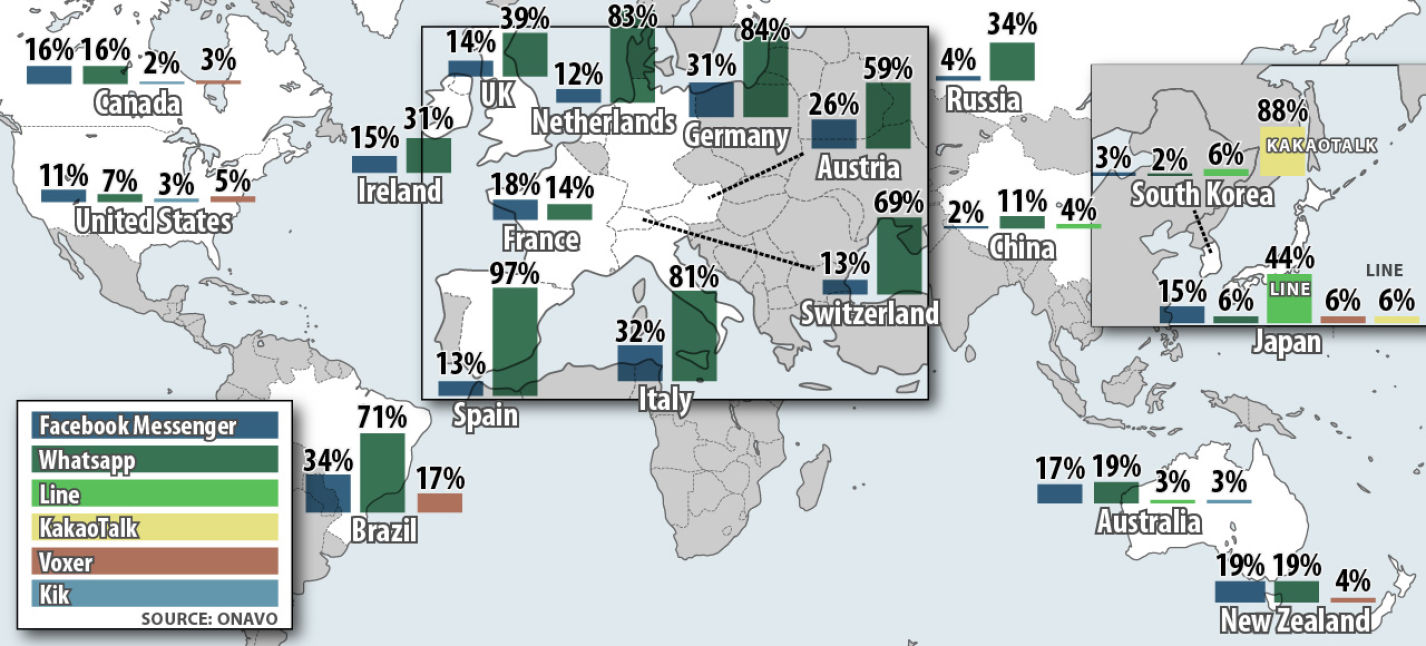
> WhatsApp will remain autonomous and operate independently. You can continue to enjoy the service for a nominal fee
Now it makes even less sense.
[0]: http://blog.whatsapp.com/index.php/2013/12/400-million-stori...