I travel quite a bit on business. One tactic I use to build relationships with customers and partners is to have them teach me how to count to ten in their language, typically over a beer. By now I know Japanese, Spanish, Korean, Arabic, French, German, Cantonese, Finnish and a couple of others I've forgotten.
What popped out immediately when learning the Finnish numbers was how long the words are. All of the other languages count with one or two syllable words. When pronounced, the Finnish is, minimum, two syllables. Three, seven and ten are three syllables. Eight and nine are four:
yksi
kaksi
kolme
neljä
viisi
kuusi
seitsemän
kahdeksan
yhdeksän
kymmenen
Twenty-First is: kahdeskymmenesensimmäinen
I've always wondered what it was about the history of the language and culture that led to this. Finnish does quite a bit of concatenating words to create other words. It was originally the same for numbers. For example, the longest, eight: kahdeksan was originally, literally, 'with two ten'. You can see hints of this in that kaksi (two) contains 'ka' and 'dek' references a borrowed word 'deca', ten.
Learning Finnish involves learning two dialects, spoken and written, and the spoken dialect can vary considerably even between cities 200km apart. But it's an incredibly fun language to learn. Very logically constructed, few(er) exceptions to the rules, and if you can say it, you can spell it!
I'm Finnish and I have to say I've never heard anyone say "kahkytyy" and it ... looks weird, too. "Kakskytyks" is the form I'd use. (Also, "yy kaa koo nee vii kuu seit kasi ysi kymppi" for the first 10 numbers.)
My dialect is from the Turku region, for what it's worth.
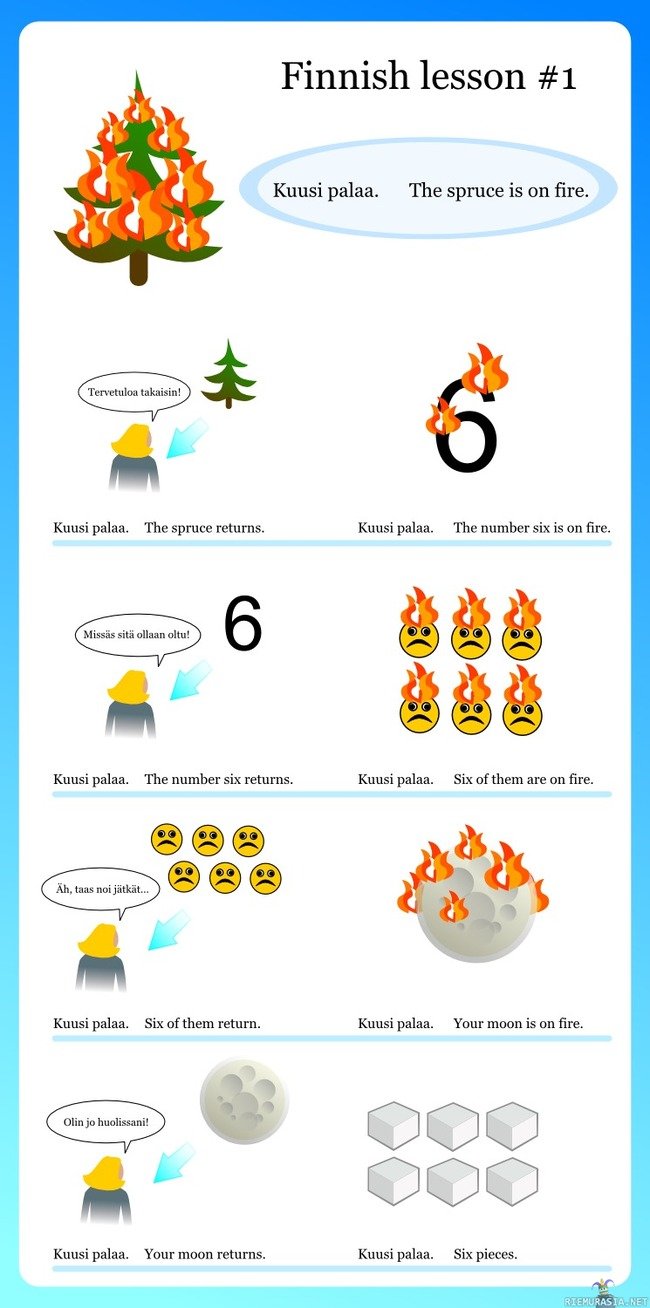
Ha! My son does a similar icebreaking thing with folks of different culture/language. He asks them how to say "Excuse me, your dog is on fire!" Has it in 5 or six languages now.
Growing up in the US, I learned Finnish from books and maybe some official radio/TV, as well as family. My cousins in Finland made fun of me for speaking like a book: I'd always choose the first sentence you presented and they'd just gawk. "Who talks like that?"
I knew lots of old words they'd never heard, though, since I was practiced at speaking with 70-year-olds who'd learned from their immigrant parents. A little linguistic time warp...
What the others pointed out, sorry for not linking directly. I was on iPad and searching on a separate tab, copying and all the hassle was slightly too cumbersome... And you may have already seen it :)
> What popped out immediately when learning the Finnish numbers was how long the words are.
Interestingly, the Estonian numbers are basically the Finnish ones with the last syllable chopped off: üks, kaks, kolm, neli, viis, kuus, seitse, kaheksa, üheksa, kümme.
I think that Estonian, by the virtue of having been in contact with more different languages and cultures, is kind of a "time travel to the future of Finnish language". They seem to have dropped a lot of the unnecessarily complicated endings etc.
As a Finn i find it most hilarious when it comes to counting the Olympics, e.g. "Kahdennetkymmenennettoiset talviolympialaiset" would be "twenty-second winter Olympics". Even our sport journalists have troubles getting those n:s and t:s correctly pronounced.


What popped out immediately when learning the Finnish numbers was how long the words are. All of the other languages count with one or two syllable words. When pronounced, the Finnish is, minimum, two syllables. Three, seven and ten are three syllables. Eight and nine are four:
yksi
kaksi
kolme
neljä
viisi
kuusi
seitsemän
kahdeksan
yhdeksän
kymmenen
Twenty-First is: kahdeskymmenesensimmäinen
I've always wondered what it was about the history of the language and culture that led to this. Finnish does quite a bit of concatenating words to create other words. It was originally the same for numbers. For example, the longest, eight: kahdeksan was originally, literally, 'with two ten'. You can see hints of this in that kaksi (two) contains 'ka' and 'dek' references a borrowed word 'deca', ten.
Ref. http://goo.gl/Zt2WBb